The Luckiest Generation – or not?!

Everyone thinks the music of their generation was best – I’d of course say ours definitely was! 

We had the benefits of the hang over from the big bands and the Sinatra years of Swing of our parents, as well as the Rock ‘n’ Roll era, the Blues, the Jazz, the Beatles, and the Stones (and the rest). And not just the best music – we had the best of post war housing and the birth of the NHS.

 In the Sixties everything seemed to be on the up for ordinary people.

In the following decades we experienced massive strides in technological developments, including IT and medicine. The first heart transplant, the contraceptive pill – better detection, better prevention, eradication of diseases etc. 

Yet, with all these miraculous advancements, for our generation and particularly for the younger generations that follow things are now going from worse to worse. Why?

The answer is the profit based economic system is failing us. Capitalism is not fit for purpose. 

Covid and Climate Change are graphic illustrations of the systems failings. The short-sightedness of Capitalists who put their profits way above everything else, including the future of the planet.

 I just want to focus on the deterioration of our NHS and in particular the medical profession’s attitude to women’s and to men’s health.

It was bonfire night 2008 and I was coming round after a hysterectomy, which I had been resisting for several years hoping nature would ‘run its course’ without intervention. I was 53. In the world of profit my childbearing purpose was spent, and I was expendable. 

I still had the words of my old GP ringing in my ears from when I first raised problems in my mid 30’s – “what do you expect at your age?”! But in terms of life expectancy 53 is barely middle aged, and I was still in need and deserving of a quality of life. 

In 2008 I was still working and was very fortunate in having a very understanding and supportive team and mangers. Although my experience was good, I understood for many other women it wasn’t and still isn’t the case, and I wrote an article at that time for our Branch Magazine. It was prompted by something I’d read by a woman who experienced very poor treatment by a less than understanding boss. 

So why am I focussing on this now and has anything changed?

For far too long the ‘Menopause’ has been little discussed. If it is talked about at all it is usually with a sense of ridicule around hot flushes and ‘ doolally ‘ women who are scatter-brained and forgetful. My own daughters are now approaching ‘that age’ and approaching what is called the perimenopause. This is the very start of hormonal changes, which can be very gradual and very long. I am learning, through their experiences that twenty or so years on from my own nothing much has changed. Too many women and too many medical professionals know and understand too little

Symptoms that are typical for many (peri)menopausal women are misdiagnosed. Too many are sent away with anti-depressants when HRT (Hormone Replacement Therapy) is a much more appropriate, effective, and safer way to address the issues. So much for the developments and advancement I spoke of earlier!

Puberty alongside sex education has long been part of the school curriculum, but not the menopause. It is therefore not surprising that bosses and mangers (of whatever gender) have little or no understanding. More alarming is the absence of training in the medical profession – Only 42% of medical students study the subject and the menopause is not a compulsory element of a medical degree!

It is important that women and their partners have a clear understanding of this period in our lives and that workplaces have suitable policies in place to support and not vilify women. Government Departments often run courses on health and equality issues and Menopause needs to feature in those programmes.

This link to a Webinar The Menopause Explained is an excellent insight, dispersing the myths about HRT  that sadly some GP’s still cling on to.

And what about Men’s Health? I think it fair to say that men get a bit of a raw deal when it comes to preventative medicine. Women have been encouraged to have regular cervical smear tests and breast screening for many years. These have proved vital in early detections of cancer and opportunities for treatment that has saved countless lives. But Prostate Health and regular screening for men is non-existent. In fact, many men experience difficulties in persuading there GP to send them for a PSA test, even when there are compelling reasons. I recently heard of a GP telling a patient they are “not allowed” to offer a PSA Test and will only give it if requested. Too many still refuse.

A PSA test measures the amount of Prostate Specific Antigens in the blood. While this test alone is not a definitive detector of Prostate Cancer, regular testing will provide information and an opportunity for early detection, – and early detection is key. Prostate cancer is not itself life threatening. It is failed detection that allows the cancer to spread throughout the body and that is the problem. Early detection can save men from the spread of cancer, save them from more serious and unpleasant treatments such as chemotherapy, and ultimately save lives. Men are said to be notoriously bad at seeking medical advice – let’s make that a myth too!

We are currently fighting to retain our National Health Service and to reclaim it from private hands. Many are unaware of how much of the service is now subcontracted and in the hands of the likes of Virgin. As capitalism chips away at all that is good and prevents all those advances from being used for the benefits of all and not the profits of the few, we have a battle on our hands.

Menopause and Prostate Cancer awareness are just two health awareness issues we need to take up in the workplace and actively campaigned on through the unions, not least our own.

VOTE Yes/ Yes To Stop Spread of COVID in DVLA

Please read our attached leaflet on why members should vote Yes/ Yes in the DVLA Ballot

MOJ Pay Deal

Dave Bartlett (Group Executive Committee Member-personal capacity)

The membership in MOJ have now voted in favour of the recent offer with 89% in favour, although the numbers voting have not been released. The three year deal which traded conditions for pay was opposed by Broad Left Network supporters in MOJ.

As the only member on the GEC and as a member of the BLN, who came out against the offer, I am still not surprised that this offer was accepted. For many members on the lowest grades ,the attraction of a two year back pay in the next pay packet and a pay increase of 11% over three years became, in the absence of any national campaigning, the only alternative that was on view. As one member put it “this is the best we are going to get in the circumstances”.

However it would be a huge mistake to interpret the result as a massive endorsement for the union and satisfaction with the outcome. This deal is a classic case of concession bargaining where there is a clear line between gainers and losers. What you got in the offer depends on who you are, how long you have been in service and where you work. For some members of many years service  and are at the top of their grade, the offer falls well short of the 11% the deal is said  to be worth. One legal adviser said to me  “if you add in the proposed national insurance increases then the offer amounts to just 0.75%”! And of course this does not take account of inflation which is expected to nullify the value of the deal over it’s three year life time.

The MOJ keep saying this offer will now make the department competitive with other sections in the civil service but that is fantasy. The lowest bands still trail behind while the average salary for legal advisers is £8000 less than an equal comparison in other departments such as the Crown Prosecution Service. If the MOJ was serious about narrowing the gap then why have they insisted that in order to pay for these increases they are taking off Paul to pay Peter?

 As part of the deal overtime payments will go down to 1.25 (on average they are  double in the DWP).  DSOs instead of a 5% top up  will be replaced by a £500 payment which is a cut. Allowances of all types will be cut.Its not surprising therefore that a huge number of legal advisers and admin members will chuck in their voluntary Saturday workings as from October when the new rate comes into force. DSOs are also reviewing their positions and some have already resigned before the ballot result was announced.

The union has declared that 600 new members have joined during the ballot. Its always a positive development when we see new members joining which can only benefit us all in standing up for workers rights  in the workplace especially during this very difficult period.  

The union must now make every effort to keep those members and indeed get some to become involved in union activities. Otherwise there is a danger that many of those could leave the union if it is not seen as relevant to the small everyday matters as well as the crucial matters on health and safety ,pensions and future terms and conditions. If this is not done then many of those who joined in this campaign might just fade away having cast their ballot as was the case in the MEP rejection offer a few years ago.

Some members will gain from this deal in the short term but if we are to avoid deals which sell off conditions and reward some and not others  we need to absorb the lesson – there is no substitute for national collective bargaining for a proper pay campaign around a minimum 10% with no strings. 

Instead the Left Unity national union leadership abandoned conference policy at the outset of the pandemic telling members as well as senior management “now is not the right time” as they parked the 2020 pay claim. The effect of this was to weaken the confidence of members and strengthen the hand of the employer.

Out of this failure we have now seen a shotgun marriage of concession bargaining in the HMRC earlier this year and now in the MOJ. Trading pay for conditions has been embraced by the Democratic Alliance (Left Unity/Democrats) union leadership at national and group level as a way of avoiding a fight against the government attacks on our pay. They have abandoned the national pay campaign and the 2021 10% pay claim for concession bargaining.

BLN members will continue to demand that the union national leadership launch a national campaign for an across the board increase of at least 10% and to link up with other public sector unions making similar demands.

Socialist Change Not Climate Change – PCS Must Build For COP26

From 31st October to 12th November, the 26th United Nations Climate Change “Conference of the Parties”, known as COP26, will meet in Glasgow. This was scheduled to happen in 2020 but was cancelled due to Covid-19. Pressure is growing on world leaders to take decisive action on climate change. A generation of school students, participating in “climate strike” walkouts from school, have already made their voices heard.

In almost every trade union in the UK, motions have been debated at national Conferences which commit the unions to fighting for a “just transition”. This means a shift away from a carbon-emitting economy in a way that protects working class people from job losses and higher prices and taxes. 

The capitalist class, who see the climate crisis not as a threat to the planet but as a threat to their profits, have also been exerting pressure. In their populist mode, the capitalists hire useful stooges like Alex Jones to pour conspiracy theories and climate change denialism out into the internet and the airwaves. For COP26, however, the capitalists will be rubbing shoulders with world leaders and such tactics will be far from view. Quite a number of large polluters – energy companies, corporations reliant upon global supply chains and banks – have taken to sponsoring COP26, to ensure that they can pose as concerned whilst making sure their profits are protected by governments.

Working class people have no such privileged access to these leaders. Dramatically widening inequality, decades of anti-union laws and the shattering of socialist politics in the mainstream left parties have all ensured that workers have no seat at the table. Only by mobilising workers across the UK – and across the world – will we ensure that our voice is the loudest, so that bosses and politicians are left in no doubt that the burden of de-carbonising the economy should be borne by the wealthiest.

Fight for One Million Climate Jobs and a Green Workers’ Recovery

On 20th July, the union’s Assistant General Secretary, John Moloney, issued a circular (Branch Bulletin 99/21) which lays out the need to build a campaign in anticipation of COP26. This includes giving support to a climate strike on 24th September, by using it as a day of action, and preparation for major demonstrations on 6th November. 

We agree with this bulletin and call on all Broad Left Network supporters to raise its contents at union meetings. However, the danger, given the right-ward trajectory of the current leadership of the union under Fran Heathcote and Mark Serwotka, is that these good intentions are left suspended in mid-air. Outside of ensuring to get their faces on union material, or posing alongside other worthies for a photo opportunity, there is no real sense that the leadership are trying to push this amongst members, to raise its profile and build participation at a crucial moment.

Politically, there has been no attempt to take issues and political demands – such as for a just transition or for the public ownership of utilities – and ground them in real issues faced by members of PCS in the workplace. This was the advantage of the demand for one million green jobs, first articulated by BLN supporter and former PCS Assistant General Secretary Chris Baugh. At the time we first put this forward, it was in answer to the devastating job cuts unleashed by the government after the 2008 crash. It connected directly to a burning issue.

This can be done again, in the context of the Covid-19 crisis and the economic slump that is already hitting jobs up and down the UK. The one million climate jobs we identified included the creation, within the UK Civil Service, of a National Climate Service. This could coordinate the creation of green jobs, with state-led investment to reverse a generation of under-investment. It could transform sectors like manufacturing, energy and transport.

Such an organisation could also have links to every single workplace, especially those run by the government. The current Tory government has published a sustainability strategy – but it amounts to fine words. When it comes to the institutions which the government controls, any reduction in carbon footprint will be by slashing local offices, ditching office car parking spaces and services and by getting rid of the tens of thousands of additional staff taken on during the Covid-19 crisis. In every way this is the opposite of a “just transition”.

A National Climate Service, with sweeping powers to get the UK economy to zero carbon emissions and yet to protect the interests of workers, could link up with Green Reps in every workplace. Green Reps, members of, appointed by and accountable to the trade unions, would speak up for workers’ interests while simultaneously pushing employers to address questions like how to reduce energy consumption like electricity and heating, how to invest in the fabric of buildings, how to rationalise transport usage and so on.

It is these local aspects of fighting climate change – defending jobs, workers’ control in the workplace – that we must use to mobilise in every workplace.

With billions of pounds of debt built up by the crisis, with county court judgments for debt skyrocketing and 650,000 businesses reporting serious financial distress, an economic crisis is happening right in front of us. Swingeing government cuts are an inevitability, once the heroic role of nurses, teachers and others fades a little. If we do not connect the battle against climate change to the fight for jobs, then it will be spun the other way by bosses, their politicians and a compliant media, that climate change necessitates suffering for workers.

If we do not use this opportunity, this huge mobilisation that has the potential to be felt in every corner of the country, to demand economic justice, the result will be much like the aftermath of 2008. The Labour government at that time bailed out the banks, preserved the profits of the capitalists and the obscene bonuses of their financial lackeys and used the resulting debt as an excuse to gut spending on public services, the poor, parents, the sick, the disabled, the young and the old. This mantle was gleefully donned by the Tory and Lib-Dem coalition.

We must mobilise now.

How Could We Build The Mood In Our Workplaces?

There is reason to believe that a mood to fight could quickly build up around the question of jobs and a green recovery. In our own union, workers are already facing job cuts. This is one of the reasons for the current 2-week strike at Just Ask Services, at the Royal Parks. Other private sector contractors will likewise be scaling down staffing, as additional cleaning measures adopted during the pandemic are abandoned by the government.

Staff like this exist in virtually every civil service workplace, and in addition there are the tens of thousands of Fixed Term Appointments taken on to deal with Covid. There are also vast backlogs in certain areas which clearly indicate the need for still more workers to be recruited. Staffing – and related issues such as work related stress, workloads and so on – is an extraordinarily potent issue, if the leadership were to include it in our National Campaign.

This must not just be – as the bulletin referred to above has been – a one-off announcement from the leadership. Nor should it be just Zoom meetings or surveys, designed by the leadership to pointedly avoid any discussion of a strategy to win and to demoralise and demobilise members, as in the recent DWP Safety Campaign. It will have to be a serious effort, involving detailed discussions with reps at every level, painstaking confidence-building amongst branches and then a clear plan to connect all of this back to the major protests planned for COP26 November and to take it out to the entire labour movement.

This mood is strong enough that it is forcing action even in unions traditionally considered to be bastions of the right-win, such as USDAW. Strike action at Weetabix in Kettering, or at BCM Fareva, which supplies Boots and the Body Shop, has resulted from threats to jobs. In Glasgow itself the battle at McVities revolves around the threat to 500 jobs. Any one of these factories could be re-purposed to produce the infrastructure on which a green economy would be based.

BEIS, the Department for Business, Energy and Industrial Strategy, which has oversight of COP26, has been hard at work trumpeting the future potential of the “hydrogen” economy. Total government investment is a paltry £105 million and looks a lot like a Tory green-washing exercise. Instead of this, civil servants could get to work mapping out factories and workplaces threatened by closure, identifying available machinery and skill sets and required investment, so as to support workers to take over and run these factories to build green infrastructure.

Inevitably there will be opposition – both from the entrenched bureaucracies within the trade unions and of course from the political class, the capitalists and their minions in the media.  Workers could be mobilised, however, and given the confidence to strike and occupy factories threatened with closure, to demand nationalisation and to demand that the government drastically scales up its investment in the future zero carbon economy, starting with their jobs.

Workers Can Link Up With Students

The twin demands of reducing carbon emissions and a green recovery that protects jobs are universal. The school students who took strike action in 2019 are finishing school and looking around for jobs. Their options are limited. In Glasgow, even in skilled areas such as teaching, councils – faced with economic crisis – are refusing to permanently employ those they take on as trainees. There is scope for a massive campaign that unites workers and students.

Workers – and their organisations, the trade unions – must take the lead, allied to combative campaigns with a proven track record, such as Youth Fight For Jobs. Union branches must pro-actively approach Trades Councils, as is suggested in the PCS branch bulletin referred to above, but we can and should also approach university, college and sixth form students unions, to ask for their support and involvement in making an impact on November 6.

Young workers and students want jobs, they want rights at work and they are absolutely fed up with a capitalist class which has no answer to climate change except an unending series of international junkets in Kyoto, Paris, Copenhagen, now Glasgow. Their lived experience is of their future being endlessly threatened, wages undermined, jobs casualised, pensions evaporated. A socialist approach to these issues unites workers and students.

Every union branch should show a lead in reaching out to the rest of the labour movement, and the union’s National Executive Committee should instruct the network of union offices across the UK, the Full Time Officers and the regional and devolved nation committees to support this work. The union is also affiliated to campaigning organisations that can help, including the National Shop Stewards Network and, as mentioned, Youth Fight for Jobs.

In Glasgow, Youth Fight for Jobs is already organising on campuses for a demonstration outside Skills Development Scotland, in which PCS members work. Firstly, to protest the Scottish Government’s acquiescence in the exploration of a new oil and natural gas field in the North Sea, but also to demand better support for workers and students, in the form of jobs. A lunch time demonstration by workers at Skills Development Scotland, to show support and solidarity, would allow for a broad discussion of the socialist demands needed to win.

Local issues are also worth highlighting. Controversy has raged over the exploration of a new oilfield off the coast of Scotland, with the SNP-led Scottish Parliament in support. It is defended as a necessary evil, and as propping up jobs and investment in the north-east of Scotland. Such a view is only sustained by the under-investment in renewable energy needed to reduce carbon emissions and keep fossil fuels in the ground. In other parts of the UK, fracking or wood pellet burning are well-known issues that can be raised.

Scotland is actually ahead of most of the rest of the UK in terms of its generation of energy by renewable means, but this is not to praise the Scottish Government, it merely reflects the lack of urgency being shown by the Johnson’s Westminster government. A little less mired in corporate corruption though it may be, the Scottish Government has nevertheless passed on massive cuts to local authorities, affecting every area from adult social care to rubbish collection and recycling.

Council leaders frequently blame their inactivity on issues like climate change on these cuts. We don’t accept these excuses but this should underscore how the reversal of austerity is the most obvious and immediate step towards the kind of job creation and investment that would sustain a green recovery and take a giant step towards a zero-carbon economy. 

All of these issues – defending jobs, defending local services, making every workplace as green as possible – are relevant in virtually every community across the country. Achieving them is not just compatible with the demand for a zero-carbon economy – they are dependent upon each other. This is the banner under which the trade unions must prepare for a major battle – beginning with the mobilisation laid out in the PCS branch bulletin, but going beyond that.
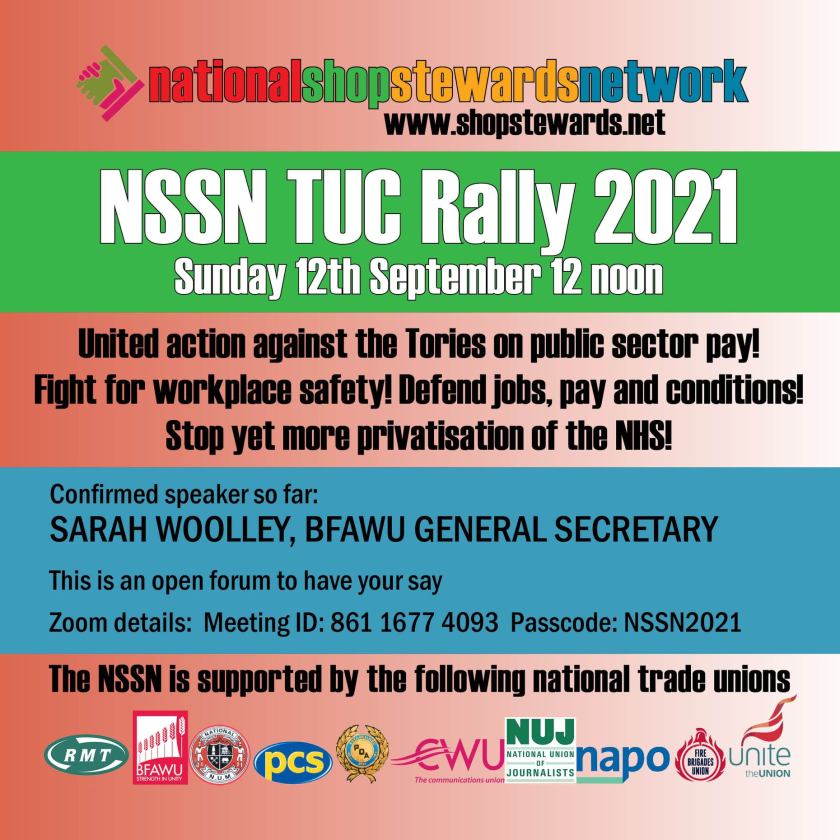
Join the NSSN lobby of the TUC

The National Shop Stewards Network has a proud record of mobilising the rank and file of the trade union movement to put demands on the TUC for the fighting programme that is needed by workers. The 12th NSSN annual lobby of the TUC will take place at noon on 12th September. PCS is one of the many unions affiliated to the NSSN. And we recognise the important role the NSSN has in supporting PCS members whenever they are in dispute and on picket lines.

The lobby will be virtual again this year with the TUC congress also taking place online. It will be an open forum for union reps to have our say from the fight for workplace safety, to defending our jobs and hard won pay and conditions, to stopping yet more attacks and privatisation of the NHS. The BLN is encouraging PCS reps to attend this lobby to have our say in building the resistance to the attacks.

It has never been so important to build the fight back to the attacks. The pandemic has seen workers fight for their lives and increasingly our livelihoods as bosses and the Government unleash an offensive to make us pay for the crisis, including the public sector pay freeze, cuts in our living standards, attacks on our services, putting our members at risk, as well as the widespread attack on jobs and conditions with fire and rehire and union busting. This is a great opportunity to get union reps together from all the unions fighting the government’s attacks on our pay across the public sector and work to build a coordinated campaign to meet our demands for a full pay rise to address the years of pay restraint.

Workers are fighting back, with a strike wave that has seen important victories. Come and hear about the action that is taking place from union leaders and shopfloor workers on the front line who are leading the fightback.

All Welcome

Confirmed speakers so far:

Sarah Woolley BFAWU General Secretary, 

Joe Simpson POA Deputy General Secretary

Joe Kirby RMT NEC

Sharon Graham UNITE General Secretary

Facebook event

Zoom details:-
https://us02web.zoom.us/j/86116774093?pwd=OVNvZldISGozKzd6U0QvL1hBWEI3Zz09

Meeting ID: 861 1677 4093
Passcode: NSSN2021

DWP Attacks Staff and Claimants’ Safety

DWP continues to ignore safety of its own workforce.  It has instructed managers to complete risk assessments in Jobcentres to push staff, working from home, and claimants, back into the offices. This is a pre-planned cynical attack on safety, driven by a Tory ideology more interested in profit and pressurising claimants off the books.  DWP, in an act of utter opportunism and cynicism has utilised the peak holiday period – knowing many PCS reps will be on leave. The Left Unity led Group leadership have a responsibility to act quickly against this overt attack from the employer. A collective response is needed that doesn’t abandon reps to manage safety in isolation.

Legal duty

Return to work and office arrangements should be agreed with PCS. The DWP has a legal duty to protect both the workforce and the public who visit our offices. This includes preventing the transmission of covid-19. The employer must carry out a health and safety risk assessment for any planned changes.  Regulation 4a of the Safety Representatives and Safety Committees regulations requires the employer to consult safety reps in good time. “In good time” means they must factor in time for safety reps to receive information, express views and importantly take account of PCS views before making decisions on required safety measures.

Severe Risk

Despite the vaccination, covid-19 still poses a significant risk to public health. The number of cases is rising – over 200,000 positive test results, 635 deaths and nearly 5½ thousand hospitalisations in the past week.  The risks of contracting covid-19 remain severe. Increased risk of covid means increased risk of long covid. A significant number of long covid victims end up with long-term conditions which can have a severe impact on individual’s ability to undertake day to day activities and even work.  17.8% of workers who contracted covid-19 are no longer working because of the impact of long covid.  It disproportionately impacts on working age adults and even more so on women. The way to prevent this is to stop the spread of the virus; the way to reduce the spread of the virus is to stay at home.

No-one should contract covid from working in or being called into DWP workplaces

Poor ventilation and enclosed spaces mean that indoor spaces remain the riskiest environment. The immediate consideration must be the elimination of the hazard of contracting covid-19. This means continued working from home. Where workplace attendance is agreed, 2m social distancing must be maintained, ventilation must meet the necessary standards, good hygiene levels and face coverings worn.

DWP Management attempting to tear up safety measures

Management’s revised covid-19 JCFRA and checklist documents have been updated to reflect the government guidance in England. Management have removed all reference to 2m social distancing and instead refer in passing that close contact should be avoided – a recipe for chaos and disaster. And completely ignores the Welsh Government guidance that physical distancing is required and this should be 2 metres wherever this is practicable.

HSE guidance is clear: measures already in place should continue, including no desk sharing, proper cleaning of workstations between users, one-way systems maintained, screened desks used for interviewing the public, flexibility in start and finish times to allow for safe travel.

Response is Pitiful – Group Wide Industrial Action is Needed on Safety

Unfortunately, the PCS Group leadership has yet again been found wanting. Whilst they have been meeting the employer, they have singularly failed to prepare members and reps for action if our safety demands are not met. They have squandered vital time and achieved little in talks. Members’ confidence must be built including the confidence to take the necessary action to win. The Left Unity led GEC have demonstrated an abject failure of leadership by kicking the can down the road, relying on meaningless surveys, abandoning reps to fight alone and doing little to build any serious campaign.  How has the GEC used the 74% indicative jobcentre safety ballot result in favour of action to build the required response? They haven’t.

Interim Measures for Branches and Regions

In the meantime, whilst the GEC fails to lead, we cannot abandon members and reps in the face of these attacks from the employer. Reps should call emergency branch and regional committees to assess the situation. Member’s meetings should be held to challenge the attacks, publicise and take action if required under H&S rights and make clear the support for the demand for a collective group wide response which must be put if management don’t step back. Safety for all is a key issue to link up with organisations that represent and support claimants to develop a joint campaign of action.

Discuss and agree the following motion to help put the pressure on the Group leadership to lead:

“This meeting recognises the major attack on safety to staff and claimants through changes to DWP Covid Safety measures. This meeting instructs the PCS DWP GEC to build the necessary campaign, including a statutory ballot for strike action, if the employer refuses to put safety of members first”

PCS needs to hold the line on safety with the following demands:

  • Minimal staffing levels agreed and only to deliver essential work that cannot be done from home.
  • Retention of all covid-19 safety measures to stop onward transmission of covid in the workplace.
  • Keep 2m social distancing at all times.
  • Maintain extra cleaners doing touchpoint cleaning in DWP sites
  • Deep cleaning following positive cases.
  • Ensure all indoor spaces are well ventilated with fresh air throughout the day, using CO2 monitors.
  • Face coverings to be worn in all public spaces and when moving around workplaces
  • Flexibility for workers to travel when it is quietest and continued flexibility about working hours.
  • Full risk assessments to continue and kept under review with the union health and safety reps
  • Individual risk assessments for workers with underlying health conditions, clinically extremely vulnerable workers, black workers and for those not yet vaccinated. And results fully taken into account.
  • Full support and reasonable adjustments for workers suffering from long covid – sick leave written off for pay and discipline purposes
  • All staff who have been in close contact with covid cases or have symptoms must self-isolate.
  • No use of quick lateral flow tests to reduce self-isolation time

Support for transport unions’ demands for face coverings and social distancing to be reinstated on public transport.

Reject the MOJ Pay Offer. Fight for more pay and no strings!

Personal statement from Dave Bartlett

I am on the MOJ Group Executive and a member of the Broad Left Network. I am opposed to the proposed MOJ pay deal and attach to this article a copy of the leaflet we are issuing to encourage a NO vote.

We’ve waited 2 years without any pay increase for this offer and to be honest its delivered very little. 10.3% over 3 years is not a lot especially as inflation is running at 3%. and many members will lose out in their conditions of employment.

This is the reality of concession bargaining. The pay offer is an average computation, depending on who you are and where you are.  The lowest grades(AOs, AAS etc) do benefit, although the offer includes adjustments to fit in with the legal requirements of minimum and living wage. The  scourge of regional pay does come to an end as employees now come under 2 brackets of a London wage and a new national wage but a number of members will suffer a loss from these arrangements. 

To pay for the gains in this deal there is a cut in allowances, and overtime, affecting many such as DSOs, legal advisers, bailiffs . Those members on 35 and 36 hours (mainly in the GMB union) will have to move to a standard 37 hour week and will receive a non consolidated compensation package. 

This is an offer subject to collective bargaining. In other words it will need to be accepted by all the unions and will apply to all members of staff.

This is an offer I feel we can’t support. Some grades may gain in the short term  but sacrificing employment conditions is not my idea of what unions should be doing. 

At the end of the day this is the price union members are paying for sectoral concession bargaining and above all the abysmal failure of the national leadership in abandoning any notion of a national pay campaign. 

Five members of the current GEC sit on the NEC and supported a no strings 10% national pay claim for all PCS members in 2021. This deal comes nowhere near our union’s claim so why are they supporting it ?

And why has it all been done in secret ? Until the last minute hardly anything was known about the deal and then at  an emergency August meeting of the Executive (which I missed as I was on leave) they recommended support ( PCS Democrats/Left Unity Alliance) with a really short period of consultation before the ballot starts on the 20th August. 

I have written to the GEC calling for the ballot to be put back to give a chance to all members to have a say and to see where the balance is between winners and losers.

If the deal goes through in reality then the MOJ together with HMRC is another section taken out of national bargaining  for the future. We should take a stand now to stop this happening . Demand from the MOJ and national union leadership a campaign to unite members around this year’s 10% claim and the action needed to secure it.

UPDATE ON DVLA DISPUTE

The dispute at the Driver and Vehicle Licensing Agency (DVLA) over COVID safety is now in its fifth month.

Whereas only a skeleton staff of around 250 was required to attend the workplace during the first wave of the pandemic, over 2,000 of the Agency’s 5,500 strong workforce had been forced to return last September making a serious outbreak during the second wave almost inevitable.

After balloting members in March this year, PCS embarked on a strategy of prolonged targeted strike action, bringing out selected groups of members at different times and paying them £40 a day strike pay. Originally, the main demand of the union was to drastically reduce the numbers required to attend the workplace, by offering more homeworking. However, this has since been amended to focus on a demand for agreement on a phased, controlled return to the workplace when it is safe to do so.

The employer made an offer in late May which included commitment to an agreed timetable to return to the workplace, as well as a one-off financial payment of £200 to all staff and 2 days flexi credit. It appears that this offer would have been recommended to members to end the dispute, but the offer was withdrawn at the last minute due to intervention at ministerial level. It is evident that a political decision was made to take on the union rather than to work for a settlement.

The targeted action is continuing with the Drivers Medical Group on strike for the whole of August. Mark Serwotka pledged back in May that PCS was prepared to fight on for months to come if necessary. However, under the anti-union legislation, there must be a new ballot to renew the mandate after 6 months and this is due in September. There will also be a consultative ballot from 11th August to build for the statutory ballot and it is essential that there is a big majority for continuing the action.

In the meantime, DVLA has been unilaterally returning more staff to the workplace with no action being taken to prevent this.

Supporters of the Broad Left Network have consistently put forward suggestions with the aim of supporting and strengthening the action. BLN supporters have advocated:-

  • Decisive action by collective use of S44 back in December/January when the outbreak occurred rather than wait until March to ballot with action only commencing in April,
  • Escalating the targeted action to include all DVLA members. It was the threat of such action that led to management’s offer in May, but the action was never carried out and has not been revived since. It is unlikely that targeted action will be enough to bring the dispute to a satisfactory conclusion. The targeted action should be linked to a move to an all – out strike if management do not agree to the union’s demands.
  • Accompany the strike action with an overtime ban. The union has not called for an overtime ban at any point in the dispute.
  • Working from home to be the default position with the necessary investment in technology to enable this. Any exceptions to be agreed with PCS. This might include critical work which cannot be delivered from home, personal and domestic reasons where the risk to the individual is greater at home than if they were in the workplace.
  • Challenge DVLA’s punitive sick absence regime that treats sick absence including COVID related absence as a disciplinary offence. COVID related absence must not count towards the trigger points for disciplinary action.
  • Stop the forced return to the workplace now taking place by deploying collective S44 notices. Increased DVLA staffing levels will make for an unsafe workplace. Workers have the right to refuse to put themselves in an unsafe environment and the union needs to intervene. DVLA cannot be allowed to win the dispute by simply returning staff to work unchallenged.

BLN supporters are critical of the way aspects of this dispute have been handled by the LU leadership, but we do so in a constructive way with the intention of strengthening the position of PCS and the members at DVLA who have responded magnificently throughout. It is unusual in that the Left Unity leadership of PCS is directly running the dispute, with zoom meetings for members chaired by the President Fran Heathcote and addressed by General Secretary Mark Serwotka. This national intervention was prompted by headline media coverage of a major COVID outbreak with over 500 cases and one fatality at DVLA last Winter. There have now been over 650 cases in total.

The focus now must be on winning the consultative ballot and the statutory ballot that hopefully will follow. It is important that DVLA members know that support for their action is as strong as ever. Please send messages of support to responseteam@pcs.org.uk.

Donations to Fighting Fund Levy, ref DVLA, sort code 60-83-01, account number 20331490.

Dave Warren

ARMS NC member and former DVLA activist

A reply to PCS Left Unity: we need a fighting leadership to win on pay

Martin Cavanagh, the union’s Group President in DWP, recently wrote a long screed calling for unity while in the same breath attacking Broad Left Network supporters on the executive committee that he chairs. Such hypocrisy is the common currency of the union’s leaders.

PCS Left Unity, the faction within the union of which Cavanagh is a member, seems to have perfected this technique, of sounding militant and like they’re taking the fight to the employer whilst doing precious little and having a go at anyone with a different point of view.

Look at the facts – they are weakening the union

Organising is crucial work for the union’s leadership. It includes recruiting and training waves of new reps, who will play the pivotal role in workplaces across the country, fending off attacks from the employer and mobilising members. Herein lies one of the biggest failures by Martin Cavanagh and his colleagues in PCS “Left Unity”.

In October 2018, the Department for Work and Pensions on its own had 82,675 staff (total number of bums on seats). At this time, the union had 1,516 union reps. This figure does not include non-rep roles such as distributors, learning reps or advocates.

In May 2021, the most recent month for which we have figures, the Department for Work and Pensions on its own had 91,784 staff. At this time, the union had 1,237 reps. These figures are already known to DWP, which publishes the number of union reps annually.

These figures are stark. In the period of these two-and-a-half years, during which Left Unity have had unchallenged dominance of the leading committees in PCS, including the National Executive Committee, the union has lost a fifth of its reps in DWP.

In a very short space of time, and despite massive recruitment in DWP, the current leadership of the union have presided over a hollowing out of the union. The figures indicating union density over this period indicate a similar failure on their part to build the union.

Broad Left Network supporters are furious about this. We know it doesn’t have to be this way. We’re in the offices. We know that members want to fight back, and we want the leadership of the union to give a strong lead, to move decisively against attacks by our employer.

This is precisely what the current leadership have not done for years now. Fiery rhetoric on Facebook is all very well, but it’s not leadership to repeatedly yell, “We support any group of members who want to go into dispute!” and then to do nothing to organise that.

It doesn’t have to be like this – we need a fighting, democratic leadership

The current leadership is messing about when it comes to safety in the workplace during the pandemic. They opposed giving a robust steer to members on the verge of walking out over safety, dampening the desire of members to fight and weakening the confidence of reps.

Instead of going out to members with a clear strategy to seek a mandate for action, following the huge recent threat to Jobcentre staff entailed by the radical scaling up to 15 face-to-face appointments a day, they went out with a consultative ballot weeks late, and no strategy.

Then, most recently, on pay, they spent most of their recent communications attacking the other civil service unions, FDA and Prospect, and absolutely none of the recent communications outlining a strategy to force the employer to cough up more money.

When it comes to safety, Broad Left Network supporters have not just argued for but practiced a robust approach to safety, including leading walkouts where necessary, by a vote of members, rather than insisting that each member bears the blame individually.

On pay, we see that Left Unity has caught up with the demands that BLN supporters were making last year. Our supporters were faced with arguments from the Left Unity leadership, that it would be wrong to campaign for the extra pay in DWP because of the pandemic. Whilst our members were being deluged with work.   

After carrying clear policy at group conference in June the Left Unity Group Pay negotiators still just sat down with management not telling members anything until the final offer was made. Another lost opportunity to bring pressure to bear whilst the talks were still ongoing.  It is no surprise that the outcome of the talks reflected exactly what had been threatened by the Tories in the Autumn Statement last year.

We urged an industrial ballot, underpinned by a host of campaign activities. These should include members’ meetings, lobbies of Parliament and model motions for other union branches and for trades councils to help organise public meetings.

Given that the NHS is very publicly moving into dispute with the government over the disgraceful 3% pay award that will be paid for by cutting services (i.e., no extra money will be given to the NHS), we are in an analogous position to other unions and need to link up with them.

We have proposed more. We need to build up a detailed picture of the ways in which our members have provided support to the most vulnerable. DWP use this to heap praise on the Department, we want this to benefit staff, through an appropriate pay award.

We think there is work to be done applying leverage to the Permanent Secretary in DWP, to force the submission of a business case to the Treasury to demand more money for a pay settlement, to deal with our 10% claim and demand for reinstatement of progression.

More than all of this, however, we need the support of branches and reps. The GEC must address the devastating loss of confidence it has inspired by its inability to do anything except write strongly-worded letters or whinge in all-members’ circulars.

When the GEC begins to look, sound and act like a campaigning, fighting, democratic union leadership, then we’ll see the number of union reps increase. We’ll see the density of the union in DWP workplaces increase. BLN supporters will keep working for that goal.

There is a clear warning in the Left Unity statement that management are gearing up to extend the return to the workplace for everyone.   But at the same time the GEC leadership rejected out of hand the practical suggestions that BLN supporters put forward to rebuild the Jobcentre safety “campaign” let alone offering a lead in building it further to cover all the members it now admits are facing the threat.

We know very well – as Martin Cavanagh admits – that a lot of what we are calling for is already the policy of the Group, sanctioned by the Group Delegate Conference. Our point is that the leadership aren’t doing this. They drag their heels. They talk down our chances. They are doing everything possible to avoid actually getting busy building a campaign or the union.

We deserve better.

Keeping Workers Safe In HMRC

On Monday 5th July 2021, the Prime Minister announced the relaxation of Covid restrictions in England. At first the message was that there would be an end to all restrictions in England but since then, the government has rolled back on some of those relaxations as a response to widespread public concerns. Nevertheless the message for workers in England is clear – you are expected to return to the office.

The devolved governments are responsible for setting their own policy for addressing the pandemic. Holyrood has generally taken a more cautious approach to that seen in Westminster and that is what we have seen again this time, although Holyrood has chosen to introduce some relaxations on a roughly similar timescale. The Senedd’s approach has been much similar to Westminster to the extent they could and have been accused of “riding the coat tails” of Westminster. But currently the Senedd is taking a more cautious approach, similar to the one being taken in Scotland, and have announced the retention of some safety measures like face coverings in public areas and continuation of the message to work from home wherever possible. This means that although the immediate response is that this is an English problem, in practice members throughout the U.K. will feel the impact over the next few weeks.

After the PM’s announcement, Jim Harra published a message on the Intranet that all HMRC offices in England would be open to staff from Monday 19th of July 2021. The original message gave a strong impression that staff would have to return to offices. A week later, after the UK Government was retreating from its original announcement, Jim Harra put out a second Intranet message in much more couched language, suggesting that staff would return to the office if they chose too.

Both announcements made reference to the right of staff to work from home for two days per week and that staff who choose to go into the office should continue to make use of that. That’s a great headline but the reality for many staff is that home working is still a privilege or even just an aspiration. There are all too common stories of part time staff being told the two days is pro rata for them, with barriers being introduced such as the need to undertake their full range of duties at home. Many staff are finding that the two days on offer is seen by their management chain as a maximum rather than a minimum.

To date the R&C Group Executive Committee (GEC) has been quick to say that these issues shouldn’t happen and to ask for the examples to raise in negotiations. This is small consolation for the members being given the message by their manager or the local branches finding themselves essentially sidelined and turned into a glorified mailbox for the GEC. This is made worse by the fact that the GEC is struggling to force the department to honour an agreement to allow staff to work from home for at least two days per week, when the bulk of HMRC staff have already demonstrated that they can perform their full range of duties at home for five days per week.

It is also worth noting that both Intranet announcements made reference to the fact there are different rules in the devolved governments. This reveals a view in the senior parts of HMRC that the Westminster position is the default or correct position and that the policies set by the devolved governments are somehow a deviation from that. They need to be seen as policies of equal importance to those developed in Westminster. This is clearly a problematic attitude that the GEC will need to get to grips with and fully address in the future.

GEC response doesn’t go far enough

Following the second Intranet message, PCS issued a members’ bulletin setting out the PCS stance. Broad Left Network members in HMRC welcome the PCS position that no member should be forced to return to the office at this stage. Covid cases are rising significantly due to the Delta variant, although hospital admissions and Covid-related deaths remain thankfully low in comparison to previous waves. However the impact of Covid has been shown to be debilitating with a range of long term conditions being grouped and given the name “Long Covid.” Long Covid is still very poorly understood, but its impact on its unfortunate sufferers has been devastating. Any increase in Covid cases will inevitably result in an increase in Long Covid cases. The evidence is clear that this is still a dangerous pandemic and generally the safest place for our members is at home.

Broad Left Network members are concerned that the PCS position doesn’t go far enough in protecting our members. We know that the heavily stats-driven areas, like the Customer Services Group, have been pressurising members to return to the office on the basis of under-performance, for example, where a member is unable to perform the full range of normal duties at home or where their manager feels they are not doing enough at home. This issue predates the current situation but to date it hasn’t been adequately addressed by PCS.

A newer and potentially more damaging development comes from HMRC’s Building Our Future (BOF) programme. This pandemic hasn’t stopped HMRC’s drive to shut offices and move staff into regional centres. This new relaxation of restrictions will more or less coincide with the opening of some regional centres.

Members who will be working in these new regional centres are being told they must attend a physical induction at their new office. Managers have been told to book all such staff on to induction events which take place when their team will be moved into that regional centre. This means that thousands of our members will be attending a new office at a time when the PCS position is that it’s too soon for a mass return to offices and that it should be the individual’s choice to return to a office. Let’s not forget too that the regional centres have all been placed in densely-populated, urban locations, meaning the vast majority of people in those offices will need to use public transport.

No matter how many measures are implemented in offices (more regular and thorough cleaning, social distancing, etc), no office can be completely safe. We also have members at risk of catching Covid on public transport and there’s nothing the employer can do to control that risk. The appropriate way to mitigate the risk is to ensure that our members aren’t put in that situation in the first place, which means maintaining home working.

Member safety must be paramount

The BOF programme may significantly undermine PCS’s position and yet this hasn’t been addressed in the recent members’ bulletin. Broad Left Network members call on the GEC to issue a clear statement that no member should attend a physical induction until they have had a meeting with their manager and furthermore, where that member has taken the personal decision that they feel safe to attend an office.

The R&C GEC should make demands that HMRC protect its workforce and the public by:

* No forced return to the workplace. Any return and on what basis only in agreement with the union

* Full safety measures to protect all members at home and in the workplace including supportive measures on mental health and stress

* Services to the public should continue to be delivered remotely as far as possible

Where work does need to be done in the workplace the R&C GEC must demand:

* Full risk assessment done with the union health and safety reps

* Keep all safety measures in place to stop onward transmission of covid in the workplace

* Minimise staffing levels to only levels to deliver essential work that cannot be done from home.

* Keep 2m social distancing at all times between everyone

* Additional cleaning of all touchpoint surfaces regularly through the day

* Ensure all indoor spaces are well ventilated with fresh air throughout the day

* Face coverings to be worn in all public spaces

* Flexibility for workers to travel when it is quietest

* Individual risk assessments for workers who are even more at risk with underlying health conditions, clinically extremely vulnerable workers and black workers. And for those not yet vaccinated.

* Full pay for all workers who need to self-isolate

* No use of sickness absence procedures to penalise those self-isolating

* No use of quick lateral flow tests to reduce self-isolation time

* Full support and reasonable adjustments for workers suffering from long covid

* Support transport unions’ demands for face coverings and social distancing to remain on public transport