Sodexo and Mitie to cut jobs at HMRC offices: In-sourcing needed to protect members

Public money used for private profit

In May 2025, HMRC moved from multiple Facilities Management (FM) contracts to one contract for the West of the UK – awarded to Sodexo – and one contract for the East of the UK – awarded to Mitie. This new model was termed by HMRC as ‘Next Generation Facilities Management’. Six months later the reality has been a backlog of repairs, offices being temporarily closed and FM staff resignations.

The new contract brings together ‘hard FM’ (maintenance and repairs) with ‘soft FM’ (cleaning, reception, cafe) to reduce the number of contracts required. This was supposed to deliver savings for HMRC. It does appear that the winning bids from Sodexo and Mitie come in at a lower cost to HMRC compared to the five previous contracts.

But cheaper is rarely better. It’s important to look at what the contracts are actually delivering to understand if HMRC is getting value for money. HMRC sets standards for hard and soft FM that are supposed to be met under the contract. If these standards are met then the contracts work.

On ‘hard FM’, key performance indicators aren’t being met. Statutory requirements aren’t being completed. Without sign off for the statutory safety of offices, they will have to be closed to staff. HMRC is then left paying rent on buildings it can’t use. Other repairs are mounting up too – broken doors, cracked windows, fallen ceiling tiles, broken taps, broken toilets, faulty plug sockets, the list goes on. Every one of these is another hindrance on the ability of HMRC staff to do their jobs effectively.

On ‘soft FM’, standards are barely met or not met. This isn’t the fault of the hard working staff – they are doing as much of the thankless cleaning and tidying at humanly possible. The problem is the cuts to headcount and hours available that are imposed from the top. Not enough FM staff means the workload is too much for those that remain and not everything can be done. The FM staff suffer the pressure of being expected to delivery the impossible, and HMRC staff suffer the consequences of unclean offices. The only winners are the companies siphoning taxpayer money into shareholder dividends. So much for being the ‘next generation’.

Ebenezer Sodexo cancels Christmas for staff

Even this isn’t bad enough for Sodexo. They are going a step further by seeking to make soft FM staff redundant all across the sites they have responsibility for. Fewer staff will make an already difficult job next to impossible for these staff. This decision is a mistake driven by corporate greed.

But consider the timing – the redundancy consultation is being conducted so that it’s completed by 19 December. What kind of Christmas will Sodexo soft FM staff, when they may not have a role in 2026?

PCS has members in Sodexo. PCS has correctly sought to intervene to support these members. Sodexo don’t recognise PCS and refuse to engage with PCS. There’s mounting evidence that Sodexo are ignoring their own redundancy HR policy and possibly employment law as well.

PCS has raised concerns with HMRC. Sodexo have assured HMRC they will still be able to meet key performance indicators, so HMRC have decided this isn’t their problem. All too often HMRC has tried to wash its hands of responsibility for privatised services. It was this attitude that allowed the Concentrix debacle to happen (see https://bln.org.uk/2025/07/08/fight-back-against-hmrcs-outsourcing-plans/). It was HMRC that suffered the reputational damage and the consequences. PCS must continue to pressure HMRC to intervene before the damage is done by Sodexo.

Mitie now implementing staff cuts

Even as PCS is looking to intervene at Sodexo, Mitie have made the disgraceful decision to make its own cuts. Little information has been shared with PCS about Mitie’s plans. Mitie what don’t recognise PCS and refuse to engage with PCS. Once again the HMRC says this is a matter for the private contractor and they can’t (or rather they won’t) intervene. 

The implication is that HMRC will have at least 100 fewer cleaning staff at offices in 2026. This would be bad at any times, but it comes even as HMRC seeks to restack it’s offices to increase capacity for people. So more members in offices using the facilities, more desks to clean, fewer staff at Sodexo and Mitie to deliver the essential services. HMRC is putting cost savings ahead of staff health and welfare.

No lessons learned by HMRC

In 2001, nearly all Inland Revenue and Customs & Excise buildings were sold to Mapeley and then leased back from Mapeley. Even at the time of this arrangement, it was controversial. Mapeley were based in Jersey so the profits of made on the contract weren’t taxable in the UK.

As time went on, Mapeley proved to be an unreliable landlord for HMRC. Repairs were slow or just not completed. The Office of Budget Responsibility reviewed the contract and found HMRC only made ‘savings’ from office closures – and those savings were inevitably offset by other costs like redundancy payments.

Time and again, HMRC has entered into contracts with the private sector that don’t deliver benefits. Whether it’s Mapeley, Concentrix, Fujitsu, Sodexo or Mitie, the private sector is a parasite on the public sector.

This Labour government stood for election in 2024 on a manifesto that included the following: 

“Labour will learn the lessons from the collapse of Carillion and bring about the biggest wave of in-sourcing of public services in a generation. A Labour Government will end the Tories’ ideological drive to privatise our public services, extend the Freedom of Information Act to apply to private companies that hold contracts to provide public services, exclusively with regard to information relevant to those contracts, to ensure any outsourced contracts are transparent and accountable for delivery. We will also extend the Freedom of Information Act to publicly funded employers’ associations, where not already covered.”

This manifesto promise – like many others – has been ignored. Along with disgusting attacks on migrants, pensioners, the disabled and the watering down of it’s promises to the trade unions, Labour is once again affirming it’s position as a representative of bankrupt British Capitalism. 

Fight back! 

This threat to members’ jobs and conditions cannot be allowed to go unanswered. So what can be done? Here is what the BLN says:

The HMRC GEC should publicly call on HMRC to end the ‘Next Generation’ FM contracts and bring the services in-house.

Current staff at Sodexo and Mitie working in HMRC offices need to be offered roles in HMRC – earning the rates of pay and terms and conditions negotiated by PCS and expected for all HMRC staff.

Every PCS branch in HMRC Group needs to recruit the hard and soft FM staff in their office into PCS. Union membership is their best protection against exploitation.

Every PCS branch in HMRC Group should organise meetings of HMRC and FM members. The meetings should be used to fully brief members about the situation in FM, and gather the views and the fighting ideas of our members.

While the ‘Next Generation’ FM contracts remain in place, the HMRC GEC must organise to seek recognition rights with Sodexo and Mitie for the staff working at HMRC offices.

A383: NEC employs malicious compliance – HMRC must continue to fight on pay!

At this year’s PCS Annual Delegate Conference, delegates voted to carry Motion A383 which called on the NEC to “proceed to a ballot by no later than mid-September 2025 if there is not satisfactory progress made to meeting our demands”.

The Left Unity controlled NEC has deliberately undermined the demands of motion A383 – instead of delivering a campaign, the NEC has caused even more damage to members’ hopes of a genuine campaign on pay.

There is action taking place in every part of PCS for campaigns related to the national campaign – including the Left Unity controlled DWP – and yet Left Unity have been very clear that the NEC does not consider this action to be evidence that members will support a national campaign. Members are actively campaigning and winning on pay and yet the NEC is using the fact that not enough members turned up to hastily arranged activist forums during a peak leave period as justification to once again effectively cancel any effort to build a national campaign.

The Broad Left Network has said throughout this period that Left Unity never intended to fight a campaign on pay and while they are in control of the NEC, the campaign will remain “paused” as it has for the entire duration of Fran Heathcote’s tenure as General Secretary.

Left Unity-controlled NEC capitulates to the employer

An article published on 01 August 2025 on the PCS website states the following:

“The union is not balloting members on offers within the limits of the remit, as the NEC has already determined that offers at this level will not be sufficient to protect members’ living standards, provide restoration for the erosion of pay levels in recent years and address the structural problems associated with low pay.”

In the September pay meetings arranged by branches, NEC speakers advised members that despite their awareness that the pay remit was not satisfactory, they instructed talks at delegate level knowing that negotiators could not accept the offer. Pay negotiators instead worked to achieve the best deal with the little they had to work with. This was an unnecessary capitulation to the Labour government by the Left Unity-led NEC. PCS could win much more in national talks and through direct action, yet the Left Unity-led NEC does not show a willingness to fight a Labour government for better pay.

A return to national bargaining is necessary and the pay remit should have been formally rejected – in action, not just words, and the leadership should have prepared for a serious dispute. Talks at delegated level result in vast inequalities across the civil service, where each department negotiates its own pay and terms of conditions. This has been in effect for more than three decades since Thatcher’s Conservative government waged its war on the civil service unions.

If the timeline of A383 was followed, PCS branches nationally should now have already balloted for strike action but the message coming from the leadership of the union is one of defeat. It is the same old tired excuses that members aren’t up for the fight, that they can’t afford to strike and aren’t willing to ballot. We heard the same in 2023 when again the Left Unity-led NEC capitulated and accepted a pay award with a one-off pro-rata payment of £1,500. This effectively ended the hard-won gains by reps and members on the ground to achieve a strike ballot in their workplaces. It did not provide a significant increase in pay, nor did it achieve pay restoration for the sharp drop in wages since 2010.

An end to the national campaign could be the start of action for HMRC.

HMRC Group conference Motion A45 states the following:

“Develop a campaign utilising bargaining, political leverage and industrial leverage to achieve our pay demands. Hopefully this will be as part of a reinvigorated civil service wide national campaign, but our Group must be prepared to ‘go it alone’ on pay if the National Campaign remains “paused” as it has been throughout the tenure of the current General Secretary”

It is clear from the decision in October that the NEC has no intention to win the desperately needed increase to the 2025/26 pay remit. In both the October and November NEC, Left Unity majority voted not to reopen the debate on the national campaign, preventing the BLN motion to build for a ballot in 2026 being heard. In both the October and November papers, the General Secretary provided no plan or comment whatsoever on how to prepare members for a ballot – it seems the leadership are content to pronounce members unready and leave things as they are. HMRC GEC, and our members, are not.

At the December GEC meeting, the Broad Left Network took the position that the GEC must agree to carry out the demands of A45 and conduct its own ballot on 2025 pay. This included the GEC to urgently submit a claim to the National Disputes Committee (NDC) to engage in a ballot of its members on 2025 pay. This position was agreed as part of the campaign and communications paper, setting the stage for a renewed battle on pay in 2026.

The Broad Left Network continues to demand:

Pay

  • A fully consolidated pay rise of at least 10%
  • £18 per hour minimum wage
  • Pay restoration for money lost since 2010
  • London pay entitlement of at least £5,000
  • All fully funded centrally and not at the expense of jobs or conditions.

Jobs

  • Oppose privatisation – End the planned pilot of the Managed Service Provider;
  • End the use of Brook Street labour and give permanent posts to all those that want one.
  • Insourcing of Facilities Management and Security staff;
  • No cuts to the CSG headcount.

Working conditions

  • Implement a four day working week with no loss of pay;
  • End mandatory office attendance expectations;
  • Ensure correct grading – we should all receive the proper remuneration for the work we do;
  • End the long hours culture – ensure all workloads are manageable;
  • Introduce a collective agreement to protect members from micromanagement;
  • Introduce a collective agreement for ethical use of Artificial Intelligence in HMRC, ensuring any benefits will advantage members such as through reduced workloads and a shorter working week;
  • Rebuild Employee Relations in HMRC – ensure meaningful consultation with PCS at all levels.

Solidarity with Houses of Parliament security staff in dispute!

Security staff in the Houses of Parliament who are members of the PCS took strike action last week on Budget Day. These members do essential work keeping Parliament, and everyone in it, safe 24 hours a day, 365 days a year, yet face vicious attacks on their pay, conditions, and rights from the same institution they keep safe. Last week marked their fourth day of industrial action, demanding the restoration of their original 8-hour shifts and the return of six days of annual leave lost when management imposed 12-hour shifts without consultation. They are also fighting for a fair pay rise after years of stagnation and for action to tackle a widening ethnicity pay gap. Members were forced into industrial action because the employer refused to come to the table or engage in serious talks with the union.

This comes at a time when the cost of living is being driven through the roof, with energy, water, rent, food, and transport all hitting record highs while pay stagnates. Meanwhile, MPs’ pay has risen much faster than the average public-sector wage (many also with extremely lucrative second jobs), exposing the glaring inequality between those making the decisions and those keeping Parliament running. Workers are expected to accept these attacks quietly, endure longer hours, lower real terms pay, reduced leave, and growing workloads.

The strike on Budget Day sent a clear message. Workers refuse to stay quiet while governments of all parties push through austerity, cut pay, and attack public services. As the Labour government stood in Parliament announcing its budget, workers were out on the picket line, taking industrial action showing the fight against the politics that attack their working and living conditions.

I am a member of the sister PCS branch in Parliament and stood on the picket line, alongside other members and MPs in solidarity with their dispute.

The challenges faced by Parliamentary security staff are not unique. PCS members across the civil service and public sector are facing the same attacks on pay, conditions, and rights. Parliamentary security staff are part of a wider wave of industrial disputes across PCS. Civilian staff at the Met police, workers at the Tate Modern and Britain, British library and others are taking strike action demanding an end to pay stagnation, casualisation, and attacks on terms and conditions.

The growing wave of industrial disputes shows the mood to fight is there!

PCS needs a fighting, coordinated approach that links the many disputes breaking out across the union into a single, coordinated national campaign capable of fighting against austerity, real-terms pay cuts, and attacks on conditions. Members are showing, and telling us, that they are ready to organise and take action and we need leadership who can harness and build that mood rather than hold it back!

No new dates for strike action have been announced, though there are plans for action on New Year’s Eve. You can support your fellow PCS members by joining any future picket lines.

As an increasing number of workers move into dispute, the need for a bold national campaign under a fighting, democratic leadership is even more pressing. If you want to join us in fighting for that, join BLN.

Defend the NHS and the civil service: PCS needs an industrial and political alternative

Virtually every part of the UK civil service is currently faced with redundancies and office closures. The Cabinet Office, Foreign & Commonwealth Office, the Department for Business and Trade and others have already launched exit schemes to cut thousands of jobs across the civil service. The Department for Health and Social Care (DHSC) is probably unique, however, in having launched an exit scheme, and then had to revisit it to cut more jobs.

Plans launched by Keir Starmer, Wes Streeting and the Labour government seek to reorganise the NHS, involve a bonfire of jobs, which could in the end cost as much as £1bn across NHS England and DHSC. Both have been given permission to overspend on existing NHS budgets, not to improve services, but to pay for contract terminations. Meanwhile some of the cuts take aim at bodies like the Integrated Care Boards, with cuts of up to 50%, the third reorganisation in a decade of how the NHS ensures services are available to patients.

Eight months on from the Starmer/Streeting announcement that NHS England would be dissolved and folded in to the DHSC, senior leaders still cannot outline a new structure, nor can they show how a restructure and job cuts to the value of hundreds of millions will improve healthcare for millions or take the pressure off hardpressed civil servants and healthcare workers. The sole concrete accomplishment seems to have been the creation of yet more executive “leadership” posts on salaries of up to £210,000!

So far, PCS’ public comments, the largest union for civil servants and the largest union in DHSC, has been limited to terse articles referencing consultation with the union, without criticising yet another attack on the NHS.

What a difference a decade makes: where is the PCS alternative?

BLN has repeatedly argued that – contrary to the existing leadership of the union’s National Executive Committee, under Fran Heathcote and Martin Cavanagh – the current Labour government is no friend of workers, and that their plans are not aimed at fixing the welfare state, fixing the NHS, fixing the cost of living crisis, fixing public services and the rest. They proved within weeks, with the attack on Winter Fuel Allowance, that they serve big business.

Our approach must be to ready the union’s members for battle across the UK civil service, across devolved areas (who will be impacted by cuts through Barnet Formula consequentials as well as by choices of their devolved administrations) and across the private sector. The recent thumping victory of the YES vote to retain the union’s political fund points in one of the directions, which we called for across our branches and regions.

A decade ago, under the 2010-2015 coalition government and its swingeing cuts, eviscerating civil service jobs, PCS was at the forefront of creating the “PCS Alternative”, a pamphlet built from the lived experience of our members, that showed the harm that would be done by the government’s attacks and posed an alternative to austerity cuts. In individual areas from Aviation to Scottish Social Security, we involved tens of thousands of members in a massive political debate on everything from benefit sanctions to decarbonisation, from tax justice to energy democracy.

Starmer’s Labour government, after 18 months in power, is getting off very lightly from the current leadership of PCS. Very little member-facing work is being done to connect the government’s anti-worker policies, and their attacks on the civil service and the NHS, to the lived experience of our union’s members. Of rising prices, of job cuts, of a recession by stealth for working people. This could be a crucial part of mobilising members to fight in their own defence. 

The illusion must be decisively broken that we either suck up whatever Labour dish out to us, or we wake up with Nigel Farage as Prime Minister. The truth is quite the reverse. 

If the trade unions do not act and function as a pole of attraction, we are guaranteed to see a massive backlash against Labour, including votes for Reform. A new PCS Alternative, this time to Labour’s austerity, and a serious political strategy that focuses upon preparing the union to stand and support candidates in elections who will stand up for our members and for our public services, are crucial weapons in the fight with a vicious Labour government. The current PCS leadership are letting us sleepwalk into that fight.

Political strategy and industrial strategy are linked

A revamped political strategy, one that begins from the perspective of what is being done to our members’ jobs, to the public services they deliver and to their communities, would be a huge step. The positive response this would receive from tens of thousands of union members would give the lie to the argument, put forward repeatedly by Cavanagh and Heathcote at the NEC, that there is no mood to fight.

Most recently the deliberate Heathcote/Cavanagh demobilisation of the union can be seen in Members’ Briefing MB-01-25, which essentially pronounced dead the union’s national campaign on pay, jobs and hybrid. This campaign was endorsed and demanded by the union’s annual delegate conference in May, based on a motion written by BLN supporters and carried through many branches AND the NEC, which for one year (May ‘24 to May ‘25) was held by the majority left coalition, although most of the things we actually sought to do were vetoed by Cavanagh as President.

We simply do not believe that there is no mood to fight. 

There is confusion. Members are deeply worried. There has been no leadership from the union’s National Executive Committee for years, especially since they shut down the strike wave in June 2023. It was this betrayal which brought a majority-left NEC to office in May 2024. There was still little leadership on display as any time momentum began to build, the President, Cavanagh, simply vetoed the next steps, and no side had a two-thirds majority to override him. And the below-inflation pay awards and job cuts keep on coming.

Cavanagh and Heathcote, whose control of the NEC is absolute, have worked through the union’s full time officers and National Disputes Committee to block moves towards action in areas such as the Department for Education and HM Revenue and Customs, further creating the illusion of an ebb in the mood of members to struggle. This is openly echoed by the supporters of Cavanagh and Heathcote on the NEC, especially in areas such as DHSC, Ministry of Justice and the Home Office, who talk down the willingness of members to fight.

In the DWP, which is the biggest PCS Group, the leadership has been pushed into action on pay by the pressure of reps and members. In a consultative ballot,  80.5% voted for strike action on a 52.3% turnout. After considerable delay a statutory strike ballot will start 5 January to force management to re-open negotiations on the already imposed 2025 pay settlement – aimed not at challenging the overall amount but to secure more money for the lowest paid grades, which does of course beg the question as to why the PCS leadership are not embarking on a national ballot to increase the pay pot. An opportunity wasted. Despite the limited nature of the pay demands, the disregarding of the 2025 DWP Conference motion A1 on pay, and the fact that many other important issues – such as office closures and hybrid working – are not included, we shall be working for a massive yes vote in this ballot.

In reality, it is the responsibility of trade union leaders to lead. If we understand that a fight is the only way to defend members and to stop the flood of job cuts, of office closures and – we anticipate – yet more real-terms pay cuts, then it is our responsibility to prepare for that fight and to give members the confidence that they can fight and they can win. We need to relearn the techniques of years gone by.

Clear briefings of reps laying out the steps to a significant strike campaign, including demands that will resonate with members. 

Meetings that seek to mobilise this crucial rep layer of the union. 

A strategy to coordinate disputes that are already live, and there seem to be plenty just now. 

A strategy to be able to ballot for and call massively disruptive strike action and to pay for targeted strike action, to force the government to move. 

Well-written materials that put forward the needed arguments as to why we need to fight and how we can win, as we called for and actually got agreed at the NEC in January 2025 – with not a single leaflet being produced afterwards to start the process of readying members.

These lessons seem to have been lost. Given the enormous pressure on our members, there is scope to change all this in very short order. All it takes is an NEC decision. Except for motions proposed by BLN supporters and allies in the Independent Left, this kind of about turn is not anywhere on the NEC agenda, including in the meeting just yesterday of Wednesday 19 November. “Campaign” papers from the General Secretary propose nothing, they are for noting only.

As BLN supporters across PCS prepare for our annual conference this December, we call on all those who want a fighting, democratic union to come to our conference to discuss with us how we coordinate across existing disputes, how we escalate disputes to win them, and how we bring the vast majority of other PCS members into these fights – on pay, on jobs, on hybrid working, on office closures and plenty else that matters to all of us. We urge you to join the Broad Left Network and help us to build the fight back against Labour austerity.
“We will not be moving to action at this stage” – PCS NEC abandon campaign to improve pay and protect jobs

It’s been nearly five months since PCS members instructed the NEC via motion A383 to build a campaign on the widest possible basis to fight for better pay and pensions, job security, and working conditions. If there was insufficient progress towards members’ demands, the NEC were instructed to move to a ballot for industrial action in mid-September. 

At the NEC on October 23rd, General Secretary Fran Heathcote tabled a paper which recommended that the NEC agree PCS “will not be moving to action at this stage.” Instead, the General Secretary simply recommended that PCS:

  • “Continues to engage in talks” 
  • issues a branch briefing to highlight “some of the positive outcomes in the delegated pay round” and advising members of the “consultation” on pay and NEC decision
  • issues a members briefing to say that we will not be moving to action at this stage, will continue to speak to the Cabinet Office, and will “keep the position under review in light of any progress in negotiations and changes to our organisational position.

Her reasoning for this, now sadly very familiar, is to allege members have “limited appetite for action”. This view was based on their three “structure tests”, their view from a hastily arranged activist forum and “ballot-ready” schools in late August and pay meetings which branches were asked to call from mid-August to mid-September. 

All this was far too late considering the mandate was to ballot members in September and run during a peak leave period. Conference adjourned on 23rd May so this lacklustre eleventh-hour gesture towards organising, following three months of complete silence, cannot be considered a reliable gauge of members’ desire and need for a fight on pay. 

BLN NEC members strongly opposed this passive approach and abandonment of the national campaign. The paper contains no plans to build the campaign required, to mobilise members and build the necessary industrial campaign to see off the threats to job and pay levels from the Tories and now Labour. Our organising position is utterly within our control – and yet according to Fran Heathcote the best we can do is wait and see if it magically improves. 

Make no mistake – this is Left Unity giving up the fight on the national campaign without achieving members’ demands, as they have done many times before. 

Failure to launch the campaign

The NEC Left Unity/Democracy Alliance majority, led by President Martin Cavanagh and General Secretary Fran Heathcote, has refused since May 2025 to build for and deliver any campaign to win on pay, jobs, pensions and conditions, in line with union policy. Rather than implement the necessary steps, including preparations for a statutory ballot, to improve the pay remit set by the UK Government (3.25% plus 0.5% to address low pay), they sent departmental negotiators immediately into delegated talks to “see what they can get”. It is blindingly obvious that a pay remit set at under 4% is not anywhere near our 10% claim or an £18/hour minimum wage. 

No remit increase means money available to employers to fund pay rises will not change – anything over 3.75% (even if this were permitted), would be funded by more budget cuts. That means job cuts, higher workloads, and/or selling off terms and conditions. A coordinated campaign, including preparation to ballot for strikes, is the only chance to force the government to increase the pay remit. 

Only one area in the whole union, the office for nuclear regulation, has increased pay bill to more than 5% but even that is only half our 10% claim. Inflation is running at CPI(Housing) rate of 4.1%. When BLN NEC members raised this Fran Heathcote, scoffed and said that “the government uses CPI” and some of these deals beat that – cold comfort for members who will be paying prices for essential groceries which are rising at 5.4% for Quarter 3 of 2025. 

PCS’s demand has always been to use RPI inflation as a benchmark, because it is a more realistic measure of price rises. The GS either doesn’t understand the significance of this, or her salary is now so high that she no longer feels any of the pressure familiar to PCS members. 

Time for more than just talks

NEC member Fiona Brittle moved a motion which censured the NEC for failure to deliver a pay campaign and set out the steps necessary to build the campaign on pay. See motion attached. 

For months, the General Secretary’s papers have shown that talks with the Cabinet Office have produced no commitments from the employer to increase the remit. The employer has simply “recognised” that the Civil Service pay bargaining could be improved in future, without any commitment to do that. However, the GS continues to give platitudes that even talking to the government is a win over the previous Tory government, and a whole two hours has been set aside for their next meeting. However, there remains no indication that they will produce anything different than they have for the last 6 months.

Pleasantries and warm words from the employer without concrete commitments mean nothing. When asked by BLN NEC members whether it had been made clear that without an increase to the 2025/26 pay remit we would seek to enter a dispute, Fran Heathcote sarcastically said “what do you want me to say, no we’ve sat there and done nothing?”. Notably, that doesn’t answer the question and certainly isn’t a yes. 

In moving the motion, the BLN asked for answers as to how anything contained in her paper would concretely move us towards winning on pay, jobs and conditions and prepare members for a successful ballot. Given that we know we must have one or leave members to face real terms pay cuts, how does her plan to “do nothing”, develop the mood and build confidence. We are not researchers conducting a neutral study, we are a trade union and have a particular objective; we want our members geared up, willing and ready to strike to defend and improve their pay and job security. 

Heathcote’s response to this was to once again blame members, and that many areas of PCS not covered by the Cabinet Office pay remit have “already settled for less than 10%”. So, there is it – the General Secretary is not particularly interested in achieving members demands (which she repeatedly calls “aspirations”), but rather a race to the bottom. 

Left Unity believe members “aren’t angry” about pay!

NEC members from the Left Unity and PCS Democrats (together known as the Democracy Alliance) “wish (ed) it hadn’t taken this long but (members) aren’t angry about 3%”, and that “everyone wants a pay rise, but members are not willing to do anything about it.”

This rhetoric is as insulting as it is wrong. It fits into a now-familiar pattern from the General Secretary and President of refusing to build a campaign, ‘testing the mood’ at the last moment after months of silence, declaring members have ‘no appetite to fight’, and abandoning the campaign. This argument goes back many years and was the same used by former General Secretary Mark Serwotka when running down the 2022/23 campaign to force acceptance of the non-consolidated £1500. No wonder members are discouraged – their trade union consistently signals to them that we aren’t up to the task of challenging the government, and even when we do get a successful mandate to strike, we will jump at any small improvement offered to return to industrial peace. 

The Broad Left Network believes that members are prepared to fight. Ballots taking place right across the union demonstrate this.  It is evidenced by the 2022/2023 ballot results and the numerous successful ballots run this year in PCS – Ofgem, Met Police, FM workers, Land Registry, MyCSP, British Library to name just a few. The General Secretary’s assertion that members don’t understand the link between their anger on pay and the need to fight is wrong – members understand that completely, but they have no faith that their union will wage that necessary war against the UK government. 

Elect a new, socialist leadership for PCS

It has been clear for a long time that the Democracy Alliance leadership of Left Unity and PCS Democrats do not have the political will or ability to stand up to the employer. They have watched the value of our pay continue to erode and threats to our jobs increase, without any resistance. Shockingly, they know this. Last year Cavanagh blocked any motions that disagreed with the General Secretary, because his faction was in a minority. This year, Groups and other executive committees writing to the General Secretary to express disagreement with her direction have received boilerplate responses saying it’s not their constitutional role to hold the NEC to account. They have also rejected efforts and requests from some Groups such as Department for Education, and HMRC to press forward with their own challenges to the Cabinet Office pay remit, on the basis that it would “undermine the national campaign”, which the General Secretary now seeks to cancel.

Who runs this union? Who makes the decisions about what we fight on? Heathcote believes it is her and a select few who agree with her. The Broad Left Network disagree – it is PCS members. Cavanagh and the NEC majority this year were elected on a turnout of 6.4%, showing how disenchanted members are with the same old inaction and lack of transparency from their leadership.

PCS members who want to fight the government on pay rather than simply thank them for meeting with us at all must unite to elect a different, socialist leadership for our union. 

Join the BLN, help us to transform this union into a fighting campaigning body capable of winning for members.

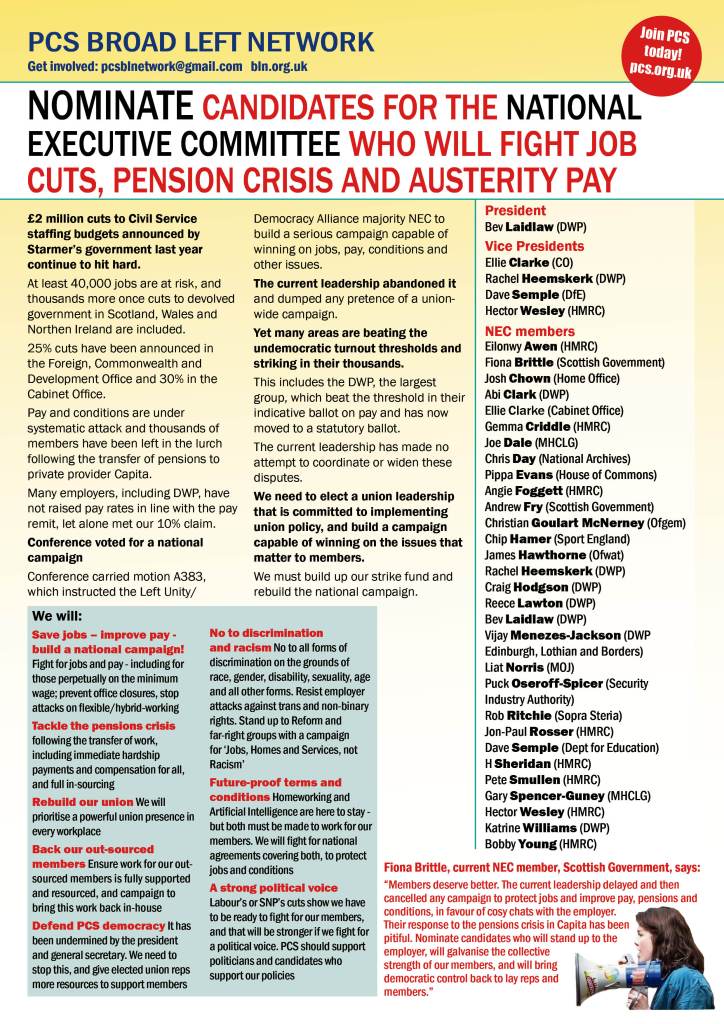
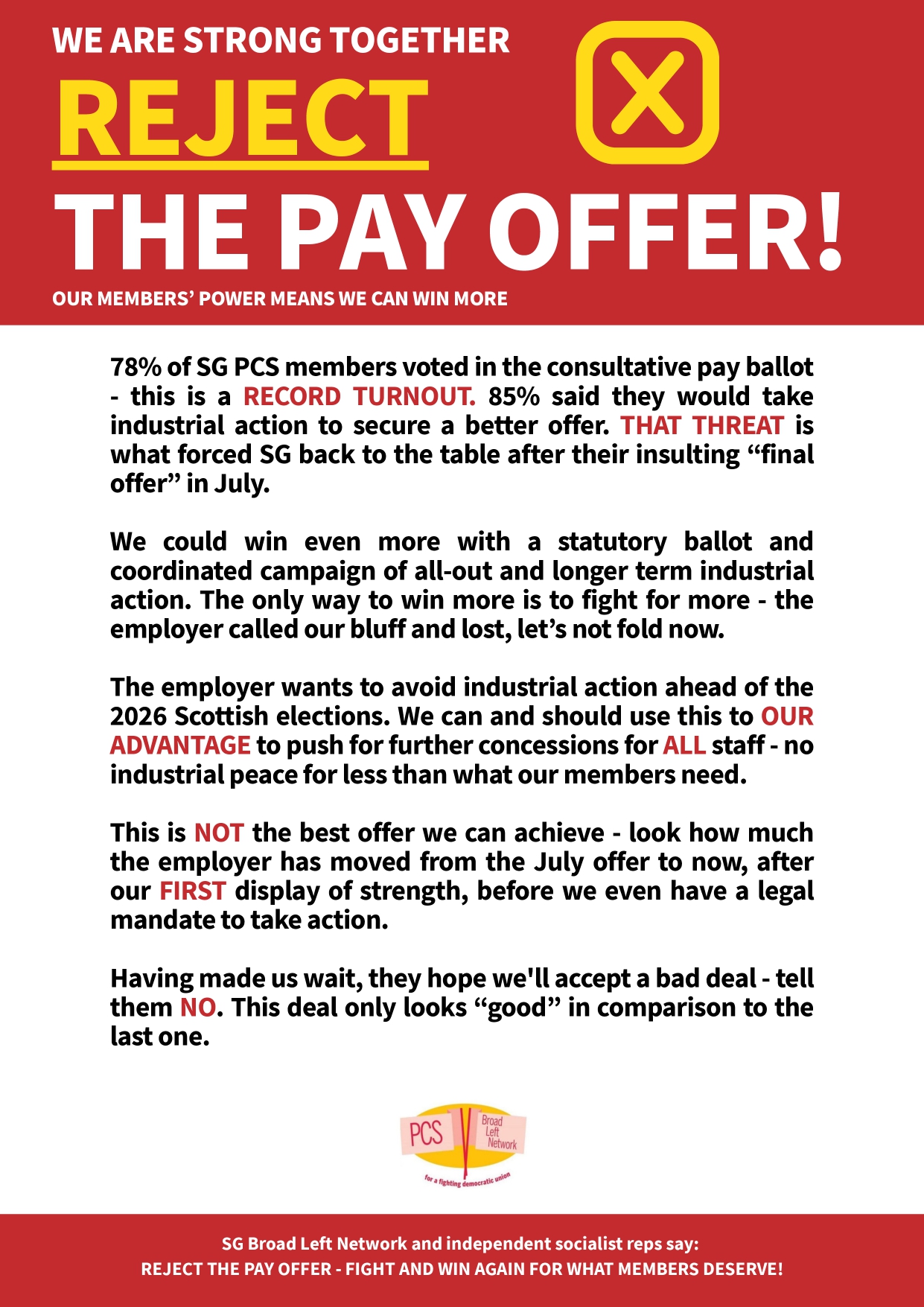
Scottish Government – Reject the Pay Offer!

Download leaflet here

Will there or won’t there be a PCS national campaign? A question of leadership

Our union’s National Executive Committee (NEC) met on 2-3 September, to discuss key matters of importance to members across PCS, including the outstanding national campaign on pay, pensions, jobs, office closures, hybrid working and more besides.

General Secretary Fran Heathcote’s National Campaign paper on the national campaign, carried a total of zero recommendations on how to achieve the aims set by PCS Conference. This was approved by the NEC majority.

Heathcote proposes no strategy, does nothing to build the mood for action amongst members, and does not project the confidence that members need to be given to decisively fight and win on the key issues.

For the avoidance of doubt this means that there was no decision to call a ballot in September, thereby abandoning the instructions of A383, without deciding any plan for what to replace it with or even to notify members. In an even more cowardly move, the NEC majority has simply and quietly refused to do what members told it to.

The paper notes a low turnout to a hastily called activist meeting, after three months of silence following the Annual Delegate Conference in May. The paper offers no solution to improve engagement or build towards the fight we know is necessary if we are to increase the pitiful pay remit figures and win proper raises for members.

Neither does it consider whether few people turn up because there’s nothing new on offer at these meetings to build a winning campaign beyond the same old obscure instruction to “get ballot ready and data cleanse”. Perhaps it is because when activists do express a view (on a special delegate conference, for example) they get ignored and accused of disunity.

This low turnout is in fact repeatedly used by the General Secretary in subsequent reports to the NEC, where the lack of activist engagement in Left Unity’s limp version of a pay strategy is used to prove the alleged lack of a mood or will to fight overall.

Further comments from the General Secretary amounted to little more than premature defeatedness and hoping to be rescued by talks with the Cabinet Office.

In the meeting, the President and NEC majority lamented that they’d all love to be on strike, if only the mood would allow. This sums up the attitude of the arch-bureaucrats at the top of PCS, both elected and un-elected. So they blame the members and the reps whilst sitting idly by doing nothing. An emergency NEC has now been called for the 21st October so we’ll see….

For socialists, this is a question of leadership.

Socialist leadership: actively build a campaign

It is almost never the case, no matter the issue, that hundreds of thousands of civil servants are ready to strike at the drop of a hat. Striking – and potentially losing money – is the last thing any worker, hard pressed by inflation, wants to do.

Socialists understand that, despite this, strike action may be the only way to achieve the necessary objectives. For the UK civil service in 2025, it’s better pay, a defence against job cuts, the halt to office closures and better flexible working to name a few.

Leadership is the ability to know which weapon is required, in the struggle with the employers. When strike action is needed, leadership is the ability to mobilise the union to accomplish this end. Heathcote and Cavanagh have neither ability.

The pressure on civil servants by Starmer’s Labour is mounting.

Job cuts are gradually finding their way to every government department, and a programme of office closures, begun in the Ministry of Housing, Communities & Local Government, is likely to expand to other government departments.

There could not be a more important time for genuine leadership at the top of PCS, but the recent NEC – following a by-now standard pattern – is, with honourable exceptions, incapable of providing it. As always, BLN supporters – Marion Lloyd, Fiona Brittle, Bobby Young and Rob Ritchie, between them representing UK civil servants, devolved civil servants and private sector members – proposed a much-needed alternative by way of a motion with actual instructions, committing to building a mood, of linking up the disputes across government departments.

In a return to form from last year, it was vetoed by the PCS President, Martin Cavanagh, so wasn’t allowed to be debated.

If the NEC won’t act, reps must

We have already signalled our unwillingness to simply wait. Across several areas where BLN sympathisers and allies hold senior union posts, disputes have begun or are about to begin. Faced with the abdication of the NEC, we must coordinate these struggles.

If you are in dispute at the moment – from MyCSP to Ofgem, from MHCLG to Houses of Parliament (all disputes actively supported by Broad Left Network supporters) – we need to work together to unite these struggles, and to coordinate with struggles that are emerging – in DfE, in Scottish Government and beyond.

An emergency NEC has now been called for the 21st October so we’ll see….

Contact the Broad Left Network (pcsblnetwork@gmail.com) to discuss how we can work together to build the broadest possible dispute, and just perhaps force the NEC to live up to its responsibility to accomplish the policies set by PCS Conference.

Trans+ Liberation motion to NEC finally heard

At Conference in May this year, President Cavanagh blocked the attempt by a clear majority of delegates to reverse the deletion of motion A57 from the agenda.

Motion A57 expressed strong support for trans members in the face of the ridiculous judgment of the Supreme Court in For Women Scotland v Scottish Ministers, and the way it has been misused by the Equality and Human Rights Commission since, to start a row about who uses what toilets.

BLN supporters, working with members of PCS Proud (the union’s LGBT+ network, which has an independent existence in PCS for exactly this reason), submitted a motion to the NEC back in May, just after the events at conference. It denounced the censoring and silencing of trans, non-binary and intersex members by Cavanagh. The motion to the May NEC also sought to overturn and force the withdrawal of a statement made by Heathcote and published on the union’s website on 17 May that required trans women to use male toilets and trans men to use female toilets while at Conference. Non-binary and intersex people weren’t even mentioned.

BLN supporters criticised the way legal “advice” had been mis-used to shut down debate.

Concern was also voiced about the decision by Heathcote to unilaterally review all previous PCS policy to make sure it is compliant with a particularly narrow reading of the Supreme Court judgment, without seeking a mandate from Conference to change policies previously set by Conference, as the democratic heart of the union.

There are so many problems with how the union’s leadership has dealt with this issue – not least in responding “no comment” to national press enquiries about the attempt by the Christian Institute to have rainbow lanyards banned in the civil service.

In short, the motion demanded closer working with PCS Proud and with the union branch at EHRC (where members have been deeply unhappy about the EHRC interim guidance following the Supreme Court ruling), to repair the damage done by Heathcote, Cavanagh and their coterie who just nod through anything they do.

All four BLN supporters currently on the NEC voted for, as did the two Independent Left supporters, and the one independent socialist – but the motion was defeated by the NEC’s Left Unity/Democrat majority.

One positive – PCS condemns the decision to proscribe Palestine Action

The union’s NEC unanimously agreed to sign an open letter condemning the decision by the government to proscribe Palestine Action.

Hundreds of people are being arrested in Parliament Square each weekend because they refuse to acquiesce in this proscription by the Home Secretary, which makes any statement of support for Palestine Action a criminal offence.

Sat beneath the statues of Millicent Fawcett and Mahatma Gandhi, these demonstrators carry signs expressing their support for the proscribed group, who damaged military property in order to stop its use in sustaining the genocide in Gaza.

Hundreds have been ungently arrested by the Metropolitan and City of London police, whose press departments lean towards suggesting the arrests are nothing short of heroic work by the police in the face of an angry, violent mob – which is just untrue.

BLN’s steering committee firmly puts on record its opposition to the proscription of Palestine Action, and will continue to support and participate in mobilisations to oppose the genocide in Gaza. In conclusion there is still business not reached or running over time including the crucial question of political representation. Importantly our motion setting out an approach in the context of political developments around Jeremy Corbyn, yet again was not reached.

TRANS RIGHTS ARE HUMAN RIGHTS – PCS Left Unity Leadership “decline to comment” on Christian Institute attacks.

The Broad Left Network stands in solidarity with all LGBT+ people. We recognise and respect the identities, dignity, and privacy of all workers in PCS and wider society. The labour movement must always work to fight for the liberation of LGBT+ workers as an inherent part of the struggle for workers’ liberty overall. 

Refusal to defend LGBT+ members

We are very concerned that our union has seemingly refused to comment  in this BBC article when asked to do so. It contains a report of legal action threatened by the Christian Institute to prevent our civil service members wearing LGBT+ identifying lanyards, listing their pronouns (such as in email signatures) and attending Pride events whilst on official business. 

In this article we explain the importance of this issue and why PCS must speak out.  PCS must defend all its members including those in the Trans+ community. “Trans+” is used here as an inclusive term to refer to all people who are trans, non-binary, intersex, or any other gender that differs from what they were assigned at birth. 

There is a complete absence of LGBT+ voices in the BBC article published 20 August 2025 but what is particularly damning is the silence of PCS. According to the BBC our union leaders “declined to provide a comment” despite being asked and despite the threat of a legal challenge directly attacking PCS members. 

PCS Proud, a self -organised group in PCS, representing LGBT+ members, were not approached by the central union to  comment, nor did PCS warn Proud this attack was likely. The President, General Secretary, the “Left Unity” NEC majority and senior unelected FTOs running the union have visibly turned away from the issue, and the silence is deafening.

This has echoes of national president Martin Cavanagh’s recent refusal to show Proud the PCS response to the recent EHRC consultation about the supreme court ruling that sex for the purposes of the equality act refers to “biological sex.” PROUD provided a suggested response to PCS nationally, but to date, neither PROUD nor reps across PCS have a clue what was contained in the final submission. It is shrouded in secrecy and one can only assume that the response is a further attempt to undermine union policy by equivocating on full defence of Trans+ people. 

PCS Conference Policy is clear – we support LGBT+ workers

Motion A317 here which carried overwhelmingly at PCS Annual Delegate Conference 2024 (and is therefore current PCS policy) states the following:

  • Biological reductionism is harmful to everyone, but especially women, girls, and the Trans community
  • Actively oppose any organisations or individuals who dehumanise others in words, deeds, or terminology thereby potentially bringing hate or harm to our minority members.
  • Oppose the introduction of any policies within the UK civil service which undermine or remove the existing rights of minorities and/or our allies, including any attempts to politicise our lives or identities.
  • Issue a public statement through all union media channels stating PCS opposition to all political or ideological beliefs that, through their manifestation, seek to dehumanise and/or increase fear or hate towards vulnerable minorities and affirming our support for the ECHR for all

Biological reductionism in this context,  refers to the notion that gender roles are simply the predetermined result of genes and chromosomes – i.e. a woman is defined solely by “biology”.

PCS is compelled by its own policy to oppose the introduction of a ban on lanyards or Pride attendance. PCS must oppose the Christian Institute who, through their legal action, seek to dehumanise Trans+ civil service workers by attacking their right to use the pronouns which align with their affirmed gender. 

Despite this clear policy and the union’s duty to defend LGBT+ members, PCS actively declined to comment on an attack within the civil service on its own members. This abandonment of LGBT+ members signals to the employer that PCS will not oppose or make any noise about this if they bow to the pressure to segregate and withdraw support for LGBT+ people, at a time where it is clear that the Labour government would like nothing more than to throw Trans+ people (along with immigrants, disabled people and other communities) under the proverbial bus. 

Left Unity’s anti-democratic attacks

The Christian Institute is not legislating against PCS, but the civil service itself. As such, PCS is free to comment on the legal case. In fact, it is the most qualified and appropriate body to comment on such cases that affect LGBT+ members in the civil service. 

While the BBC does not reference the exact question asked of PCS, it does say that PCS refused to comment on how the legal challenge could affect its members and whether the union felt they should be allowed to represent the service in Pride events. We know that the Christian Institute very clearly wants to impinge on the rights, liberty and dignity of Civil Servants based on their anti-LGBT+ beliefs. 

PCS speaks loudly (and correctly) on other legal issues involving Rwanda deportations, the Civil Service Compensation Scheme, WASPI women, etc. to name just a few. There is nothing preventing PCS – the civil servants’ union which represents thousands of LGBT+ members – from commenting on this court case. 

However, on this topic alone, the Left Unity-led leadership of PCS said no comment. This can only be because yet again the LU leadership do not want to make statements or act in support of LGBT+ rights.

We are still waiting for the statement demanded by members in ADC2024 Motion A317. LU have repeatedly blocked by undemocratically using the role of the President as NEC chair to rule out of order or delay the vast majority of NEC motions on trans rights submitted in 2024-2025.

This cowardly refusal also fits in well with LU’s recent history of blocking trans liberation and defending gender critical views, most often by using a bureaucratic smokescreen of legal advice to avoid standing up for Trans+ members. At ADC2025, the leadership of PCS successfully removed Motion A57 from the Conference agenda and did not print up to 25 emergency motions in relation to Trans+ rights. 

The fight for liberation for all

Civil Service Pride and rainbow lanyards are not and were  never the bastion of LGBT+ liberation by themselves. As socialists we know we will only eradicate hatred and discrimination through all working-class people uniting in opposition to the inherently exploitative capitalist system, and demanding sufficient (and abundant) provision for all. 

However, branding expressions of being part of or supporting the LGBT+ community as “political” and seeking to ban them demonstrates a deeper and more dangerous intent. It attempts to establish that support for LGBT+ people is not widely held, and to remove visibility of LGBT+ people as ordinary members of society. This strengthens the capitalist system by making it seem strange and wrong to be LGBT+, and somehow harmful to other people which creates a false divide of “us” and “them”. This sets different groups of workers against each other, blaming society’s ills on workers with slightly different experiences of the same desire for family, privacy etc. rather than the greed and wealth-hoarding of global corporations. It creates the idea that being heterosexual and cisgender (not transgender) is the “normal” and “right” way to be, which puts pressure on anyone who doesn’t fit that mould to change and conform, aka for their real selves to disappear. This is one of the many reasons that anti-trans rhetoric and policymaking in the UK has caused the Lemkin Institute to issue a red flag warning for risk of genocide against Trans+ people. 

The Christian Institute, in its case, suggests that in addition to being allowed to freely oppose the inclusion of Trans+ people through its gender critical ideology, it also seeks to further promote “traditional Christian views about marriage and sexual ethics”.

It is beyond the scope of this article to argue what “traditional Christian views about marriage and sexual ethics” include, but it will usually amount to criticism of the right to equal marriage, the right to divorce, the right to abortion, the right to have sex with people of any gender, and more. We have long held the view that the attacks on Trans+ rights and liberation foretell further attempts to erode, erase and distort the hard won civil rights across all equality strands and for all workers. This legal case is clear evidence of that coming true.

The Broad Left Network demands that the PCS National Executive Committee respect the sovereignty of our Conference policy, and agree to issue a statement in support of our LGBT+ members following its next meeting in September. We urge the NEC to support the motion put forward by BLN member Fiona Brittle repeatedly since May on Trans+ liberation, and act to defend LGBT+ members from these serious attacks. 

Join the Broad Left Network and stand with us as we challenge Left Unity to defend LGBT+ PCS members.

Please also read this statement from the PCS Proud National Committee on the same subject.

Download Newsletter here

NEC REPORT: 23/24 JULY 2025

Following the Emergency NEC which met on the 29th of May -Report here – further meetings took place during June and most recently on the 23/24th July. The next NEC begins on the 2nd of September. Significantly this year, the National President has stopped ruling BLN motions out of order, even though they are directly contradicting papers from the GS – could this be because they now have a majority?

This report sets out the key discussions which took place. If you want more detail, then please get in touch with any BLN comrades on the NEC.

National Campaign

Three months of sleepwalking into Starmer’s cuts

Reps and members would be forgiven for wondering what is happening with the union’s national campaign. Annual Delegate Conference, meeting in May, determined that the union needed to get serious to fight against the cuts raining down from Starmer and Reeves’ Labour government.

Since Conference concluded at midday on 23 May, the Labour government has announced a below-inflation pay rise for hundreds of thousands of civil servants, with a pay remit of 3.25%. Further job cuts – including 25% job cuts at the Foreign, Commonwealth and Development Office – have also been announced.

The outcome of Labour’s Spending Review, SR25, has also been announced. This covers government spending plans up to 2030. Departments are expected to find 15% savings in their “administrative budgets”; this is where most of the staffing budget for each department sits, so it inevitably means swingeing job cuts.

Faced with this onslaught, one would expect the leaders of the largest civil service union to be ready with a plan, including preparation for an urgent national strike ballot. With a bit of fight, a Labour government whose support in the last election was a mile wide and an inch deep could be decisively fended off and concessions won. Look at the U turns they’ve had to do on PIP, when Disabled People Against Cuts stood against them – our union could and must do the same.

PCS Leadership complacency since May

Instead of immediately engaging with reps, putting the employer of notice of a pending strike ballot and preparing organising materials asked for by the former NEC majority back in January 2025, general secretary Fran Heathcote and president Martin Cavanagh seem far too enamoured of talks with the senior leaders in the civil service, with lip service only to the idea of a much-needed strike ballot and campaign.

In a paper to the July NEC, the general secretary describes how “discussions with the Cabinet Office should give us some cause for optimism” on the questions of pay and reward. Worse, the general secretary goes on to suggest that pay restoration “be funded through finding efficiencies within the civil service”, i.e. job cuts. In the context of a government that is not hiding its preparations for attacks on the civil service over its term of office, there is no reason for optimism.

The general secretary seems lost in a fantasy by imagining that Labour Ministers are sympathetic to a return to national pay bargaining and were blocked from making progress during the Blair years only by the Permanent Secretaries (the most senior civil servants in each area). She seems to hope that now there’s a new mood at the top of the civil service and is more interested in discussing possible future changes than any movement for members right now. This kind of delusion is dangerous and disarms the union, encouraging members to put their faith in enlightened managers instead of their own power.

In fact, no progress on a return to national pay bargaining was made from 1997-2010 for a lot of reasons – but one was that Labour’s leadership bought fully into the idea of cutting public services. Starmer and Reeves still do. The language has changed slightly since the Cameron and May governments – “we’ve all got to tighten our belts; there’s no magic money tree” etc – but the basic approach to the public sector is the same. Cuts are taken to mean efficiency, and efficiency is taken to mean cuts – it’s always workers expected to pay the price by nobly accepting cuts to living standards and public services, never the profits of big business and billionaires.

Heathcote and Cavanagh appear overawed by the willingness of the Cabinet Office to meet with and speak to them, when previously the senior leaders of the civil service barely bothered even with this. However empty talks are not worth much more than no talks at all and are in fact serving as a smokescreen for no action.

This is not the first time they’ve been a little too credulous. In July 2023, Heathcote – then national president, with Cavanagh her deputy – presided over the dismantling of our national strike campaign based on a £1,500 one-off payment to members and a promise of talks on pay. They balloted members to accept the £1,500 based on these offered talks – which predictably went nowhere.

But we have also been here before with the current Labour government, during the Facilities Management dispute across a dozen sites in London and East Kilbride from late 2024 into mid-2025.

Only after months of determined strike action by privatised facilities workers in government offices did Labour’s Georgia Gould step in. Action was paused to allow for talks, but progress quickly stalled, and a victory only finally came after further ballots and action even after the intervention by Gould and the Cabinet Office. The lesson here should be clear; Labour will only step up if forced.

All this underlines that there is no room for complacency or credulity, which seems to be about all that is on offer from the Left Unity-led PCS NEC.

Will there actually be a national campaign? July NEC’s decisions

So, several months on from Conference, what has been decided?

The NEC agreed to demand an agreement on pay, jobs and flexible working across the civil service, which really is just a restatement of Conference policy with fewer added extras.

A “ballot-ready strategy” has now been endorsed, although this seems to be heavy on arranging administrative tasks such as phone banking, and light on things reps actually need for worker-to-worker conversations, like well-crafted leaflets putting the union’s case that a fight can win or support with members meetings. Delivering a successful ballot requires a campaign to reassure members that their efforts won’t be wasted this time, not just endless cold calls. Furthermore, there’s no reason any of this couldn’t have been agreed in May – why the delay?

Heathcote recommended branch members’ meetings to run mid-August to mid-September – why not immediately following the July NEC at least, but more importantly why not from the end of May? Could it be that the average LU NEC member wouldn’t have a clue what to say unless they had Paul O’Connor writing them a speakers’ brief? Or that the later they start, the less likely they are to deliver a successful ballot turnout and force Heathcote et al to have a fight on pay at all.

National PCS-run activist meetings have been lacklustre affairs so far, with no serious attempt to set out a strategy of build a serious campaign capable of winning.

Levy refund – weakening of Left Unity’s apolitical election promise

A levy refund plan has been agreed by the NEC majority, to repay the six months of levy payments which members paid from September 2024 to February 2025.

Meanwhile the creation of a “sustainable fighting fund” has been punted to the National Disputes Committee and a future consultation with branches, to conclude by the end of November 2025 – two months after the statutory ballot on pay members demanded at ADC 2025 is supposed to kick off. Presumably LU needs the extra time to work out how they can phrase asking members for money to support strikes, at the same time as paying some back because their entire election campaign was based on repaying money which should be used to support strikes and to fight the employer.

And that is pretty much it. That’s the whole plan. If that leaves you underwhelmed, and feeling like the heart of the NEC isn’t really in the idea of a strike ballot in September 2025, then you wouldn’t be alone.

Broad Left Network supporters, and allies in the wider left coalition for change – 7 out of 35 NEC members this year – opposed the above as not remotely going far enough or fast enough, and proposed a motion here that would have set PCS immediately on a “war-footing”, with preparations to match the urgency of such a posture – and the urgency of our position vis a vis a cuts-making Labour government. This motion complimented and continued the similar, highly detailed motion we submitted to the May NEC (which can be found here). Both were rejected by the NEC majority in favour of Heathcote’s delays and pleasantries.

The current situation – delegated pay, and where do we go now

Delegated pay bargaining, which negotiators were quickly instructed to enter by Heathcote immediately after the Civil Service Pay Remit was published in May, is at different stages in different areas. Major employers such as DWP, HMRC and MOJ have now concluded talks. Other areas remain outstanding with some submitting business cases for more money – but nowhere is making sufficient progress for most members.

If we’re not to simply waste all this work – negotiating on behalf of members, keeping them informed during talks, holding consultation meetings to vote on rejection of the pay award, building up pressure on the employer by mobilising members – then we need a national campaign now. That is not the course set by the current NEC.

If the NEC majority and PCS leadership remain this complacent, BLN supporters across PCS will have to come together to discuss what to do on pay in each area. We cannot rule out the need to submit employer-specific trade disputes and to build a campaign amongst a coalition of PCS branches and groups prepared to override the inaction of the National Executive Committee.

If you aren’t prepared to wait indefinitely, while the NEC tries to bury a serious national campaign in mud and confusion, join the PCS Broad Left Network and work with us to build a fighting, democratic PCS and the campaign members deserve.

Other issues to note from July NEC

Current Disputes:

Updates were given including:

  • Sacked Activists at HMRC Benton Park View
  • MyCSP striking for union recognition
  • Ofgem
  • Land Registry

Organising and Education update: Membership 187, 297 as of 25/8/2025.

Political Fund Ballot: timetable agreed, and ballot will run from 6th October. (Separately the BLN will produce material explaining why a yes vote is required and linking this in with broader political and industrial developments).

TUC Congress motions and NEC delegates agreed

The following affiliations were agreed:

Alternative to Asylum and C4C Affiliation

Strike Map

NHS

4-day week movement

Devolved Nations update which included Scotland and Wales but not NI. This provided detail on workplans for the next period. Scottish Government pay campaign was discussed, a fuller article on the BLN position can be found here.

English Devolution: a paper was agreed, despite BLN comrades raising reservations to the direction of travel, without a clear analysis on proposals across the piece.

FM Dispute: this has now been settled with members voting to accept the final offer. BLN raised reservations about the way in which this dispute had been handled whilst acknowledging the magnificent work from local reps, and particularly the strikers.

FM Workers Democracy: a paper was carried setting up an Association for FM members. BLN NEC members argued the paper should be “kept on the table” as it was clear members, reps, branches and groups had not been consulted. BLN are concerned this could be used to avoid current democratic lay structures which have been critical of the union’s handling of the FM dispute.

Supreme Court Trans Ruling presentation: – Thompsons Guest Speaker and barrister presented on the ruling, in a session which was announced just beforehand to be covered by legal privilege and therefore not for sharing to any member, branch or group despite keen interest. BLN NEC members were left unimpressed by the presentation, and without any sense that the BLN approach (shared by PCS Proud and indeed the vast majority of the union) of condemning the unjust ruling and fighting to defend Trans, intersex and non-binary (Trans+) workers is illegal, or should change whatsoever.. BLN moved that their motion on Trans+ liberation (which can be found here) should finally be taken after being pushed to the next meeting by the Cavanagh in his capacity as Chair in May and again in June. Cavanagh and the NEC majority opposed this, and it was once again pushed to September, where Heathcote is expected to bring a paper on what in her view PCS needs to do in light of the ruling.

Finally, several Rule Ten complaints were heard (See rule 10 here). This is the rule that deals with very serious complaints and are subject to oversight from the NEC.  The detail is understandably confidential and the BLN respects and understands this.  However, we raised – yet again – several points regarding errors in the process, the lack of detail given to the NEC and therefore the lack of meaningful oversight. This includes refusal to show the NEC the actual complaint to decide whether it should use its power clearly stated under Rule 10 to decide whether to commission an investigation. Instead, Heathcote reads out her own summary of the complaint and informs the NEC “for noting” rather than decision that she has already instructed an FTO to investigate. These points have all been consistently ignored by Heathcote, Cavanagh and NEC majority but we will keep pushing.

In conclusion there continued to be a lot of business not reached including new constitutions for groups, motions from the BLN on trans rights and political representation. Importantly our motions setting out an approach in the context of political developments around Jeremy Corbyn was not reached, here nor our motion on trans rights, referenced above.

In solidarity

Fiona Brittle
Marion Lloyd
Rob Ritchie
Bobby Young

REJECT DERISORY PAY OFFER IN HMRC AND BUILD FOR ACTION

HMRC has now published its pay offer. The employer has chosen to limit pay to stay within the Civil Service Pay Remit Guidance for 2025. This gave HMRC a ‘pot’ of around £90 million for pay rises, made up of 3.25% plus the option of a further 0.5% “to be targeted at specific departmental workforce issues”. 

Such a low remit doesn’t address low pay, doesn’t address the cost-of-living crisis and doesn’t address pay lost as a result of government imposed pay freezes and pay caps over years. RPI inflation was 4.4% in June 2025 when the HMRC pay settlement date fell. It means that most HMRC members will suffer real terms pay cuts again this year. This reinforces the importance of building a serious campaign across HMRC and the whole union to win our national pay demand for a 10% pay rise and pay restoration to reverse the erosion of members’ wages.

We need a national campaign on pay. A strategy to build this campaign was agreed at the PCS Annual Delegate Conference 2025 – motion A383. This called on PCS to “proceed to a ballot by no later than mid-September 2025 if there is not satisfactory progress made to meeting our demands”.

The current Left Unity led National Executive Committee (NEC) has no interest in building a campaign. June and July were wasted by the NEC. Instead of preparing members for a fight, pay negotiators were instructed to enter pay discussions at departmental level, therefore immediately diluting our ability to go back to the Government nationally to demand more money. Despite the NEC agreeing that August should be used to speak with activists and members about a campaign, there is little sign of much activity and even less signs of the serious work required to build support for a national ballot in September.

The HMRC Group Executive Committee (GEC), which includes members of the Broad Left Network, must continue to provide the leadership required to build the necessary campaign to win on pay in HMRC. In July, the GEC agreed to run a “multi-stranded union campaign” on seven major issues affecting members, including pay. The GEC are taking steps to be prepared on each of these. Broad Left Network members on the GEC supported this approach.

However, it is crucial that the GEC learn from the mistakes of Left Unity and do not repeat them. Yes, we must organise meetings to discuss with members but it is vital that we use these meetings to set out proposals for a serious campaign, capable of winning and test this approach with members. This will give confidence to members.

The Broad Left Network calls on the HMRC GEC to agree a fighting strategy to win. The GEC needs to set clear activities and a timescale to ensure we can win a statutory ballot in 2025 if HMRC is unwilling to agree to PCS demands, which are to fight for:

Pay

  • A fully consolidated pay rise of at least 10%
  • £18 per hour minimum wage
  • Pay restoration for money lost since 2010
  • London pay entitlement of at least £5,000
  • All fully funded centrally and not at the expense of jobs or conditions.

Jobs

  • Oppose privatisation – End the planned pilot of the Managed Service Provider;
  • End the use of Brook Street labour and give permanent posts to all those that want one.
  • Insourcing of Facilities Management and Security staff;
  • No cuts to the CSG headcount.

Working conditions

  • Implement a four day working week with no loss of pay;
  • End mandatory office attendance expectations;
  • Ensure correct grading – we should all receive the proper remuneration for the work we do; 
  • End the long hours culture – ensure all workloads are manageable;
  • Introduce a collective agreement to protect members from micromanagement;
  • Rebuild Employee Relations in HMRC – ensure meaningful consultation with PCS at all levels.

We call on branches in HMRC to organise member meetings to discuss these demands and the campaign required to win them. We must  prepare PCS members for the battle ahead.

Join the Broad Left Network (www.bln.org.uk) and stand with us.